
VAT registration: run the rolling and 30-day tests separately
A UK-established business generally must register for VAT if its taxable turnover for the last 12 months exceeds £90,000, or if it expects taxable turnover to exceed £90,000 in the next 30 days alone. Run these as two checks: a monthly rolling 12-month schedule for the first test and a separate forward review of expected sales for the second. Neither test uses tax-year sales, and each has its own notification deadline and effective registration date.
How the two tests differ
The past-turnover test looks back over the last 12 months at each month end. The forward test looks only at the coming 30 days. Sales from earlier months play no part in the forward test, which counts only the taxable supplies expected in that 30-day window.
Under the forward test, the effective date follows the expectation. Receiving payment later does not move it.
| Point | Past 12 months test | Next 30 days test |
|---|---|---|
| What is measured | Taxable turnover for the last 12 months | Taxable turnover expected in the next 30 days alone |
| Trigger | Over £90,000 | Over £90,000 |
| When to tell HMRC | Within 30 days after the end of the month in which the threshold was exceeded | By the end of the 30-day period |
| Effective date of registration | First day of the second month after the month the threshold was exceeded | The date the expectation arose |
Sources and context, checked :
What goes into taxable turnover
Taxable turnover includes zero-rated supplies and excludes exempt and out-of-scope supplies. The current general guide also lists certain reverse charge services, domestic reverse charge supplies and other special items that can count.
A total of sales receipts from the bank is therefore not necessarily the test figure. A workable schedule lists taxable supplies by VAT treatment each month and adds the reverse charge items the current guide counts towards the threshold. An income-only schedule can miss these, such as services bought from overseas suppliers that fall under the reverse charge. Recording the treatment against each line also makes the month of crossing easier to evidence later.
Sources and context, checked :
Hypothetical examples: one test at a time
Rolling test. A business keeps a monthly rolling schedule. In this hypothetical, the 12-month total first goes over £90,000 for the 12 months ended 31 October 2026, reaching £92,000. The threshold was exceeded in October, so the business must notify HMRC by 30 November 2026. Its effective registration date is 1 December 2026, the first day of the second month after October.
Forward test. In a separate hypothetical, on 4 November 2026 a business reasonably expects to make £95,000 of taxable supplies during the following 30 days alone. The effective registration date is 4 November 2026, the date the expectation arose, and the business must notify HMRC by the end of that 30-day period. The date customers eventually pay does not set the effective date, and earlier months' sales are not added to the £95,000.
Because the forward effective date depends on when the expectation arose, write down that date and the orders or contracts behind it at the time.
Exceptions and cases outside these tests
A business that goes over the threshold temporarily can apply for an exception from registration. A business making mostly zero-rated supplies can make a separate application for exemption. HMRC must approve either one, and neither follows automatically from the figures.
This article covers the ordinary taxable-supply tests for UK-established businesses. Non-established taxable persons can need to register without any threshold, and Northern Ireland acquisitions have separate rules.
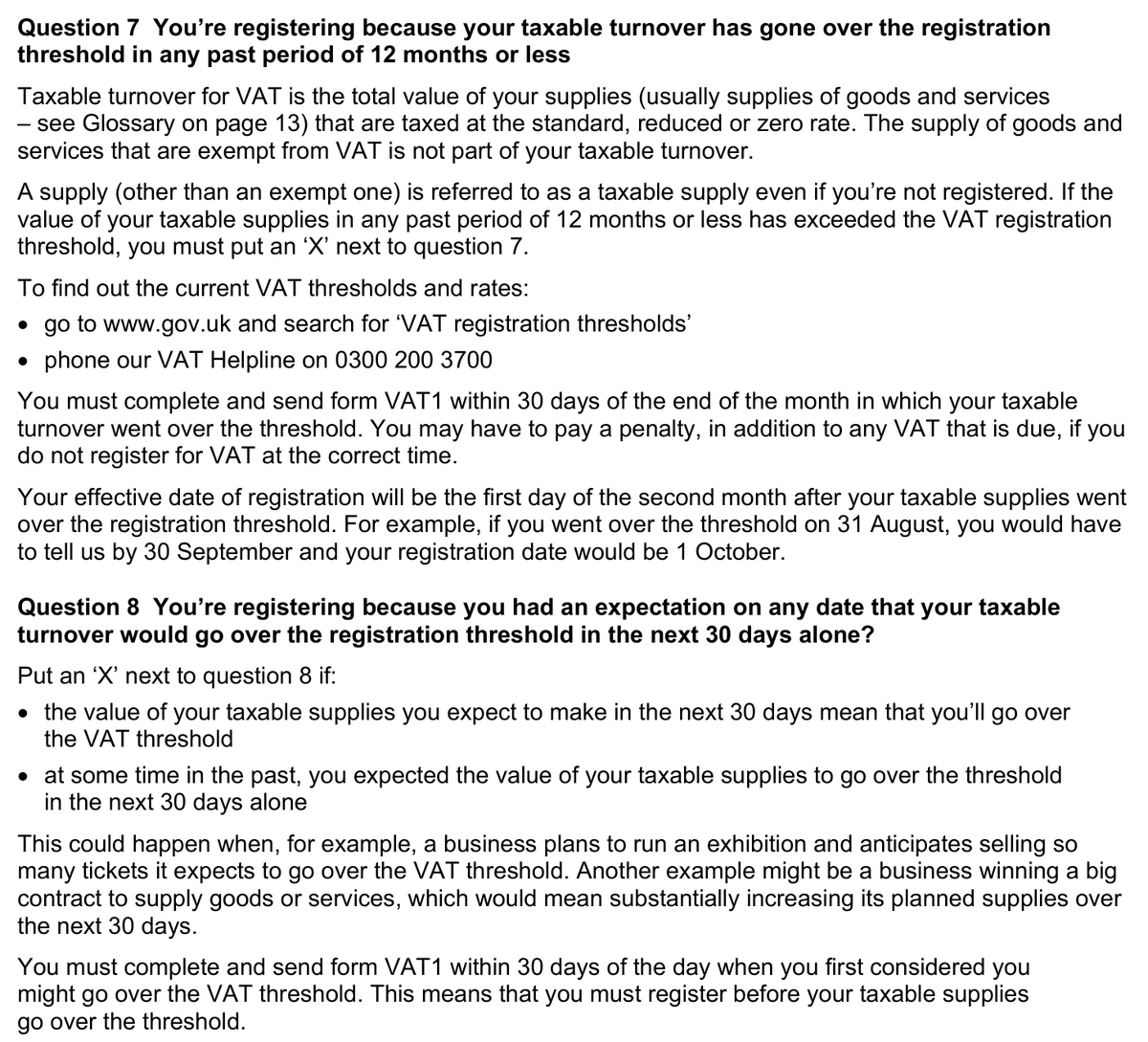
Most businesses register online. The VAT1 notes remain a useful reference for understanding the questions the registration asks.
Sources and context, checked :
Records that support the registration decision
Each test needs its own evidence. A practical file contains the items below.
Whether VAT on costs incurred before registration can be recovered is a separate question, answered once the effective date is known.
- The monthly rolling 12-month schedule, with each month-end total, the VAT treatment of each income stream and any reverse charge items that count towards the threshold
- A note of the month in which the rolling total first exceeded £90,000, if it did
- Forward reviews dated when made, listing expected taxable supplies for the next 30 days and the orders or contracts behind them
- Any exception or exemption application and HMRC's response
- The registration submission and HMRC's confirmation of the effective date