
Partial casualty loss on business property: keep the insurance claim in the calculation
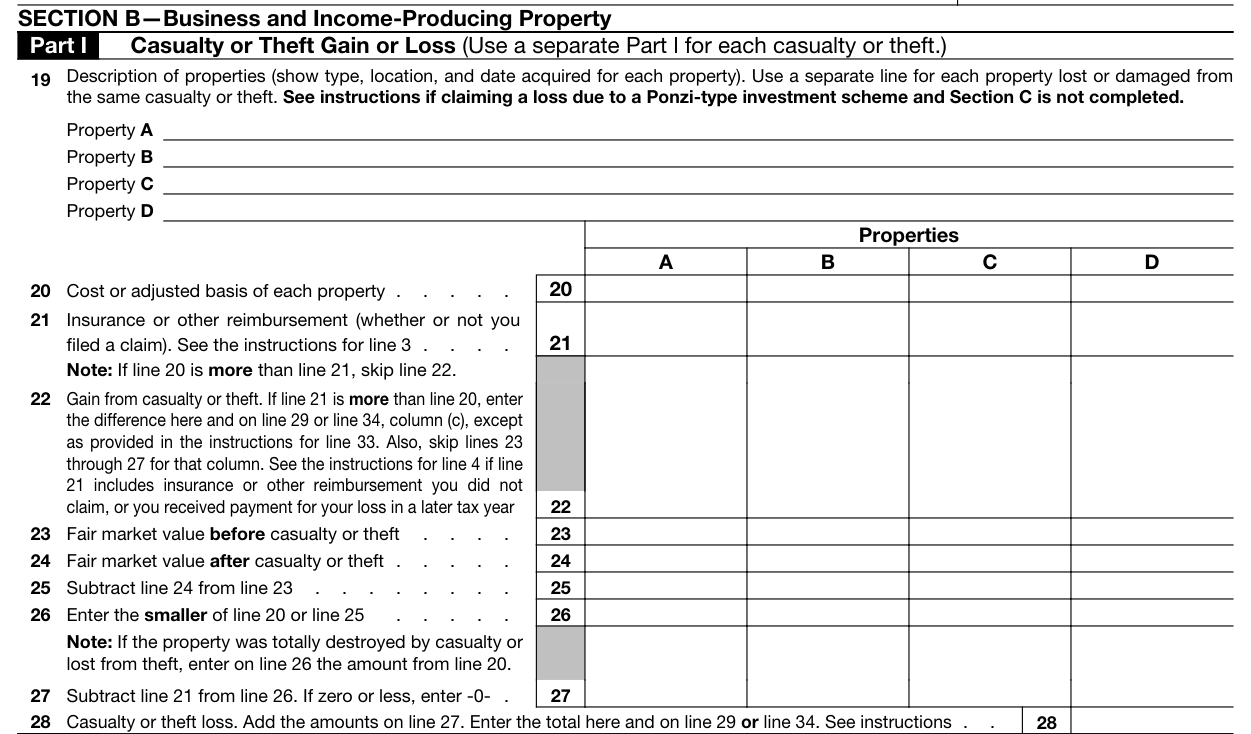
For eligible partially damaged business equipment, start with the lesser of adjusted tax basis and the decline in fair market value, then subtract insurance and other reimbursements received or expected. Any portion with a reasonable prospect of recovery waits until recovery is known with reasonable certainty, and tax basis is reduced afterward.
After the fire
A shop fire damages a piece of owned equipment, and the owner plans to repair and keep it. The bookkeeper holds a repair quote, a depreciation schedule and an open insurance claim, and has to decide what belongs on Form 4684 this year.
A casualty is damage from a sudden, unexpected or unusual event, and the loss must be proved. Normal wear or progressive deterioration does not qualify. Partial damage is figured differently from total destruction.
Sources and context, checked :
How the loss is measured
For partially damaged business property, Publication 547 measures the loss as the lesser of adjusted basis and the drop in fair market value, then subtracts reimbursements. A competent appraisal is generally used for the before and after values. The Form 4684 instructions require each item to be figured separately in Section B, Part I, and lines 20 through 27 of the 2025 final form lay out the basis, reimbursement, value and lesser-of steps.
A repair invoice is not itself the casualty loss. Publication 547 accepts actual restoration cost as evidence of the value decline only when its conditions are met. Partial dispositions of MACRS assets have special treatment and fall outside this example.
Hypothetical calculation
Hypothetical: one ordinary item of owned, 100% business equipment is partially damaged by a sudden shop fire and retained. Tax basis immediately before the fire is $18,000. A competent appraisal gives $25,000 before and $11,000 after. A final $8,000 insurance reimbursement is received in the same year, with no other recovery, no separately disposed MACRS component, no special election and no book accounting conclusion.
The $6,000 is a tentative loss on this item before return-level treatment. The $4,000 basis assumes the $6,000 is deductible and comes before any separately applicable restoration adjustments.
| Step | Calculation | Result |
|---|---|---|
| Value decline | $25,000 - $11,000 | $14,000 |
| Lesser of basis and decline | $18,000 or $14,000 | $14,000 |
| Tentative casualty loss | $14,000 - $8,000 | $6,000 |
| Remaining adjusted tax basis | $18,000 - $8,000 - $6,000 | $4,000 |
Sources and context, checked :
Insurance timing
If a reasonable prospect of recovery remains at year end, the portion that may be reimbursed waits until recovery is known with reasonable certainty. Cash received on a pending claim does not settle that question.
When insurance covers the property, file a timely claim. If the claim were disputed, only a portion independently known to be unreimbursable, documented apart from the pending claim, would be considered now. Basis is reduced for reimbursements received and for any deductible loss.
Sources and context, checked :
Asset file checklist
This workflow covers federal tax for partial damage to owned business equipment. It excludes total destruction, inventory, gain or recapture, mixed-use allocation, section 1033, state tax, financial reporting and disaster elections, and personal-use casualty tests are not used here.
Open the asset's file now and place the appraisal and insurer correspondence beside the depreciation schedule before anyone enters a loss figure.
- Asset ID and event date
- Incident report and photos
- Tax depreciation schedule showing basis immediately before the event
- Competent before and after appraisal
- Claim filed date, insurer offers and amounts received
- Unresolved amounts and evidence of reasonable certainty
- Updated tax basis, with restoration costs tracked separately
Sources and context, checked :