
Selling US business equipment: the deposit is not the taxable gain
A business sells an old machine and $5,000 lands in the bank. That deposit is not the taxable gain, and the gain on the books may not match the tax result either. For US federal income tax, gain generally equals the amount realized less adjusted tax basis. On a depreciated business machine, some or all of that gain can be ordinary income through section 1245 recapture.
Build adjusted tax basis
Original purchase cost usually starts the tax basis. Depreciation and other adjustments then change it. The depreciation that matters is the amount allowed or allowable, so basis can require reduction for depreciation that should have been claimed, even if it was not. The book depreciation schedule does not answer this question.
Selling expenses reduce the economic amount realized, although Form 4797 presents them with cost or other basis on line 21.
Sources and context, checked :
Section 1245 decides the character
An ordinary depreciable business machine is section 1245 tangible personal property. On a straightforward cash sale at a gain, ordinary income recapture is the smaller of the gain realized or the depreciation and amortization allowed or allowable. Section 179 and special depreciation can be included.
Gain above the recapture amount on qualifying property may receive section 1231 treatment, which has netting and lookback rules. That is a reason not to label all equipment gain as capital or assume a capital gain rate. A fully depreciated machine can still produce taxable gain, subject to the disposal rules that apply.
Sources and context, checked :
A hypothetical machine sale
Assume a business bought a machine for $12,000, used it 100% for business and held it for more than one year. Total tax depreciation allowed or allowable through disposal is stipulated at $9,000, which is an assumption and not a depreciation calculation. The sale is for $5,000 cash, with no selling costs, improvements, credits, debt relief, installment terms or related-party issues.
Adjusted tax basis is $12,000 less $9,000, or $3,000. Tax gain is $5,000 less $3,000, or $2,000. Recapture is the smaller of $9,000 and $2,000, so the whole $2,000 gain is ordinary income and no gain remains for section 1231.
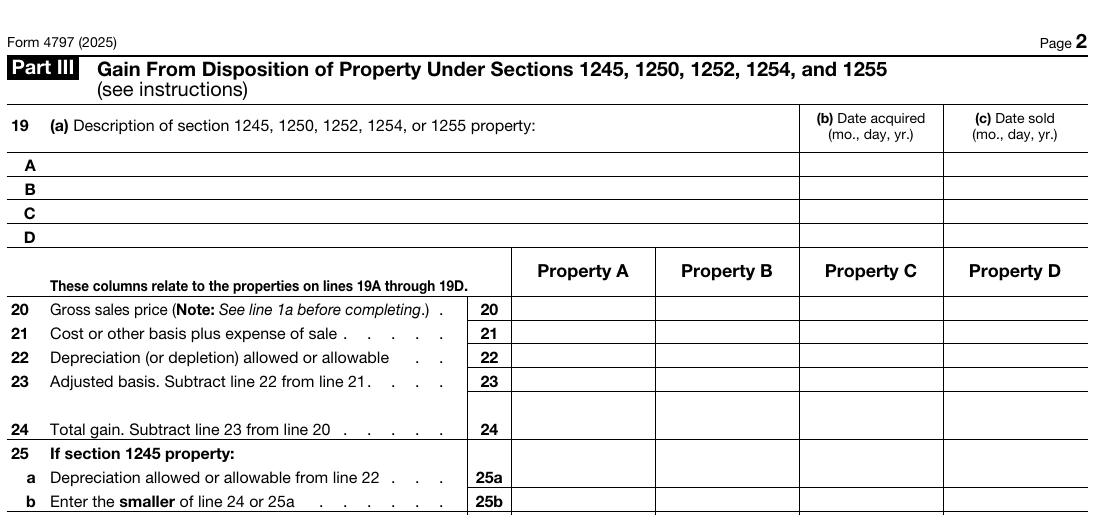
The table follows Part III of the 2025 Form 4797 to show the calculation sequence. It is not a 2026 filing template, so use the form and instructions for the actual year of sale.
| 2025 Form 4797 line | Hypothetical amount |
|---|---|
| 20, Gross sales price | $5,000 |
| 21, Cost or other basis plus expense of sale | $12,000 |
| 22, Depreciation allowed or allowable | $9,000 |
| 23, Adjusted basis | $3,000 |
| 24, Total gain | $2,000 |
| 25a, Depreciation allowed or allowable | $9,000 |
| 25b, Smaller of line 24 or 25a | $2,000 |
Sources and context, checked :
Reconcile books and tax separately
Suppose the same machine has a stipulated book carrying amount of $4,000. The book calculation gives $5,000 less $4,000, or $1,000. That figure does not replace the $2,000 federal tax gain. It is a comparison on assumed numbers, and this article does not set financial reporting treatment.
This example is limited to a straightforward gain on tangible personal property. Real estate recapture, section 179 reduced-use recapture, losses, installment sales, multi-asset allocations and state taxes need separate review. The disposal file should hold:
- Purchase basis, improvements and tax depreciation allowed or allowable through disposal.
- The sale agreement, selling costs, disposal date and tax classification.
- A reconciliation of book carrying amount and adjusted tax basis.
- A preparer check against the correct year's Form 4797 instructions and any special facts.
Sources and context, checked :