
US business travel: tax home and temporary assignments
A self-employed consultant based in City A takes a nine-month project in City B and pays for lodging there while keeping their City A base. Eight months in, the client extends the work into the following year. The lodging bills look the same before and after the extension, but the federal tax treatment can change when the expected end date moves. Before treating lodging as travel, establish where the business tax home is and whether the assignment is still realistically temporary.
Start with the business location
This guidance applies to self-employed owners under US federal income tax and does not suggest that unreimbursed employee travel is deductible. A tax home normally follows your principal business area, whatever the family address. If you work in more than one place, compare the time spent, the business activity and the income earned in each.
If you have no main business location, a separate analysis of your residence factors applies, and some people are treated as itinerant.
Sources and context, checked :
Test the trip, then the assignment
Being away from the tax home is not enough. Your duties must run substantially beyond an ordinary workday, and you must need sleep or rest to meet them. A hotel booking does not prove that on its own.
Next, test the duration. Work at a single location is generally temporary only if it is realistically expected to last no more than one year and actually does. If you expect a longer stay, the assignment is indefinite even if it ends early.
Assess that expectation at the start and again when circumstances change. The tax home moves when a temporary assignment becomes indefinite, which can happen well before the first anniversary. Repeated short assignments can be considered together, and the other deduction conditions still apply.
Sources and context, checked :
A hypothetical extension
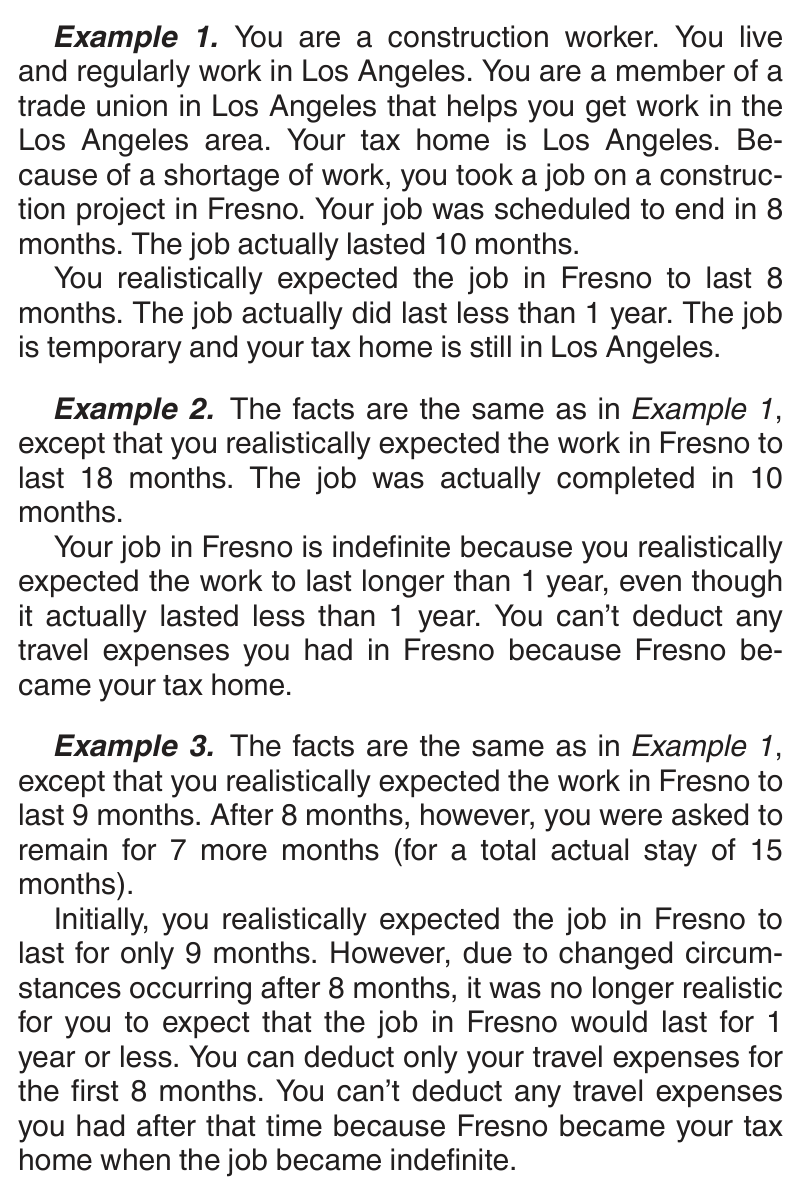
In this hypothetical, City A is the established tax home, and the City B assignment requires necessary overnight rest and duplicate lodging. No special exception applies. On 1 January 2026, the work is realistically expected to last nine months and end on 30 September 2026. On 1 September 2026, after eight months, a confirmed extension moves the realistic expected end to 31 March 2027, for a total of 15 months.
City B becomes the tax home on 1 September 2026 because the expectation changed that day. Only the first eight months remain eligible on these facts. Waiting for the first anniversary on 1 January 2027 would wrongly keep four months of City B lodging in travel. The example tests eligibility only and does not calculate a meal limit, a mileage rate or a dollar deduction.
| Period | Length | Realistic expected end | Tax home | City B lodging |
|---|---|---|---|---|
| 1 January to 31 August 2026 | 8 months | 30 September 2026 | City A | Can qualify as travel on the stated facts |
| 1 September 2026 to 31 March 2027 | 7 months | 31 March 2027 | City B | No longer travel away from home |
| Whole assignment | 15 months |
Sources and context, checked :
Evidence to keep
The date that matters is when the longer stay became realistic, which may differ from the date on a signed extension. Keep the correspondence that shows when the expectation moved, as well as the final paperwork.
Reassess the assignment before coding the next lodging bill as travel. Correcting the category then is easier than rebuilding the timeline at year end.
- Document the regular business base and work pattern before approving lodging as travel.
- Save the original scope and end-date evidence.
- Log each material extension with the date it became realistic.
- Flag repeat assignments to the same location so they can be reviewed together.
- Keep personal and commuting amounts separate from travel.
Sources and context, checked :