
Business mileage in 2026: date each trip before applying the rate
A US self-employed owner totals 2,000 business miles for 2026 and multiplies them by 72.5 cents, the rate the IRS set in December 2025. Since 1 July the business standard mileage rate has been 76 cents, so a single-rate calculation is wrong for every mile driven in the second half of the year. The date of each trip decides the rate, and its purpose decides whether it counts at all.
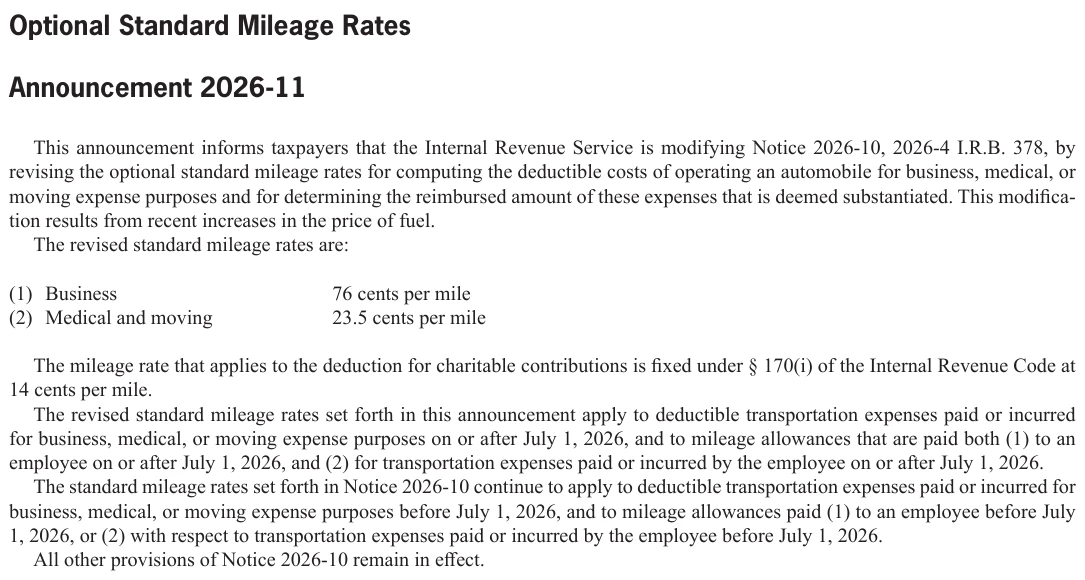
Two rates in one year
IRS Notice 2026-10 set the 2026 business rate at 72.5 cents a mile. Announcement 2026-11, published in Internal Revenue Bulletin 2026-29 on 13 July 2026, raised it to 76 cents from 1 July 2026. Business miles driven from 1 January to 30 June use 72.5 cents. Those driven from 1 July to 31 December use 76 cents.
The rate is optional. A self-employed taxpayer who qualifies can generally compare it with the actual expense method, but keeping a mileage log does not by itself make the standard rate available.
Sort the journeys before multiplying
Publication 463 treats travel between home and a regular place of work as commuting, which is generally not deductible. Travel from one business location to another can qualify. A journey that starts at home is not automatically a business trip. Whether a home office or a temporary work location changes the answer depends on the facts, so those trips deserve their own note in the log.
Most employees cannot deduct unreimbursed car expenses, apart from limited statutory exceptions. Employer reimbursement is a separate process with its own rules, and this article covers only self-employed use.
Sources and context, checked :
What a useful log records
For each business use of the car, Publication 463 asks for the date, the destination and business purpose, and the miles driven. The year also needs a total mileage figure, so business, commuting and other personal miles can be told apart. An odometer reading proves distance but not purpose. A calendar entry supports purpose but does not prove the miles. Our suggestion is to keep both, together with appointment confirmations, client records or delivery notes that tie each trip to the business.
The publication asks for records made at or near the time of the trip, and treats a weekly log that accounts for the week's use as timely. Where records are incomplete, it allows other sufficient evidence and, in limited circumstances, reconstruction. That is a fallback, not a method to plan around.
Sources and context, checked :
A split-rate calculation
This example is hypothetical. The taxpayer is self-employed, eligible for the standard mileage method and has chosen it. Every trip is dated, supported and separate from commuting.
Applying 72.5 cents to all 2,000 miles gives $1,450, which is $42 too low. The $1,492 is a vehicle expense figure. It is not a tax refund or the amount of tax saved, and it comes before any separately eligible business parking and tolls.
| Period | Qualifying business miles | Rate | Amount |
|---|---|---|---|
| January to June 2026 | 800 | $0.725 | $580 |
| July to December 2026 | 1,200 | $0.76 | $912 |
| Total | 2,000 | $1,492 |
What the rate already covers
The standard rate generally takes the place of the car's running costs. A taxpayer using it does not also deduct fuel, repairs or depreciation for the same vehicle. Business parking fees and tolls can be claimed on top, under the normal rules.
Some vehicles cannot use the standard rate at all. The method chosen in an earlier year for an owned or leased car, fleet use, and earlier depreciation or section 179 deductions can rule it out. Check the vehicle's history against Notice 2026-10 and Publication 463 before relying on the rate.
Sources and context, checked :
Before the year closes
Pull every trip logged in late June and early July and confirm it sits on the correct side of 1 July. Then review the journeys that start or end at home, and look for months where total miles rose but business miles did not, so personal driving is explained before the figure reaches the return.