
How the $5,250 education assistance limit covers tuition and student loans
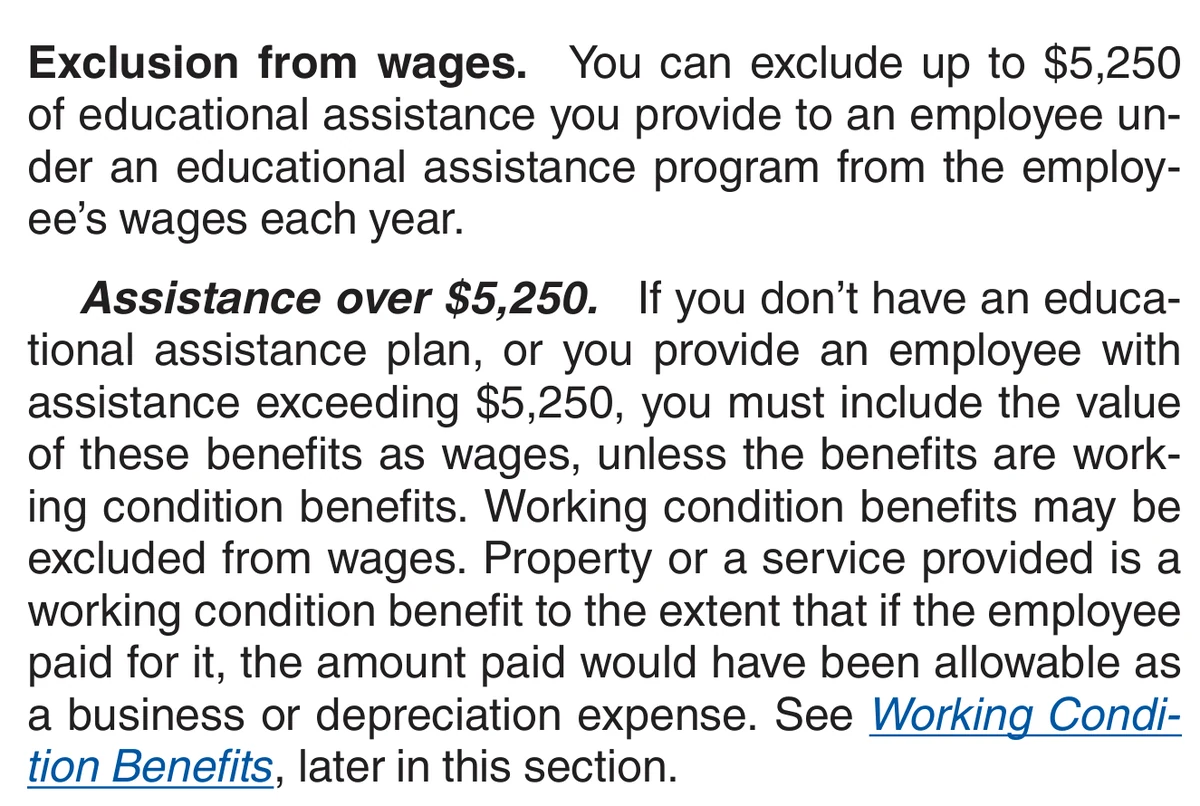
For US federal payroll in 2026, a qualifying section 127 plan lets an employer exclude up to $5,250 per employee from wages for the calendar year. That single limit covers education assistance such as tuition and payments on the employee's own qualified education loan, so add the two together before testing the cap. Anything above $5,250 is wages unless a separate working-condition fringe exclusion applies.
The plan has to exist before the exclusion does
Section 127 requires a separate written employer plan for employee educational assistance. Its eligibility and benefit rules cannot favor highly compensated employees. Shareholders or owners who hold more than 5% of the business, together with their spouses or dependents, can receive at most 5% of the program's benefits for the year as a group. Eligible employees must get reasonable notice, and the plan cannot offer a taxable cash alternative.
That owner limit bites in small companies. If the people most likely to use the plan are owners, the 5% cap can leave little or nothing excludable for them. Check the plan design against the limit before telling an owner that $5,250 will be tax-free.
Publication 15-B treats assistance paid without a qualifying plan as wages unless the working-condition exclusion applies.
Sources and context, checked :
One limit for tuition and loan payments
The 2026 exclusion is up to $5,250 per employee per calendar year, counting educational assistance and qualified student loan principal and interest together. On 20 April 2026 the IRS updated its section 127 FAQs to reflect the permanent extension of employer student loan payments after 2025. Inflation adjustment of the limit begins with taxable years after 2026.
An older IRS FAQ from 2024 is still online and says the student loan benefit ends on 1 January 2026. The April 2026 update supersedes it.
The loan must be a qualified education loan the employee took out for their own education, so a loan for a child's schooling does not meet the test. The plan must cover loan payments, and the employer can pay either the employee or the lender. Any unused part of the yearly limit is lost. It does not carry forward.
What expenses count
Tuition, fees, books and eligible supplies can qualify. Graduate courses count, and the course does not have to relate to the employee's current job.
Meals, lodging and transportation do not qualify. Neither do tools or supplies, other than textbooks, that the employee keeps after the course ends.
Get substantiation for each payment. An expense excluded under the plan cannot also support another education deduction or credit for the employee. Calling a payment training does not change its treatment either. An amount over the limit stays wages unless it separately qualifies as a working-condition fringe.
Hypothetical example: tuition plus loan payments
Hypothetical: an ordinary employee, who is neither an owner nor highly compensated, participates in a written, nondiscriminatory 2026 plan covering both tuition and loan payments. During 2026 the employer pays $3,500 of substantiated tuition and $2,000 of principal and interest on the employee's own qualified education loan.
Tested separately, each category looks comfortably under the cap. Combined, they exceed it by $250, which goes through payroll as wages on the assumption that no working-condition exclusion applies.
| Item | Amount |
|---|---|
| Tuition | $3,500 |
| Qualified loan principal and interest | $2,000 |
| Combined 2026 benefits | $5,500 |
| Section 127 exclusion | $5,250 |
| Excess included in wages | $250 |
Records and payroll decisions
Keep one ledger per employee, ordered by payment date, with tuition-type assistance and loan payments in separate columns and a running combined total. Payroll can then see the remaining calendar-year room before approving each payment, and the excess is caught in the pay period it arises.
The supporting file can hold these items:
- The signed written plan and proof that employees received notice
- Yearly benefit totals showing owners stayed within the 5% limit
- Receipts or statements for each education expense
- Loan statements showing the employee as borrower and the loan funding the employee's own education
- The pay date on which any excess was added to wages