
Partner payments: separate guaranteed payments from draws
A partner in a US partnership receives a fixed $24,000 for services and takes another $10,000 from the business bank account in the same year. The ledger calls both amounts draws, and the partner expects their income from the partnership to equal the $34,000 received. Those figures can differ, because the partner's profit share may not match the cash they took out. Start with the partnership agreement, then classify each amount.
Read the agreement first
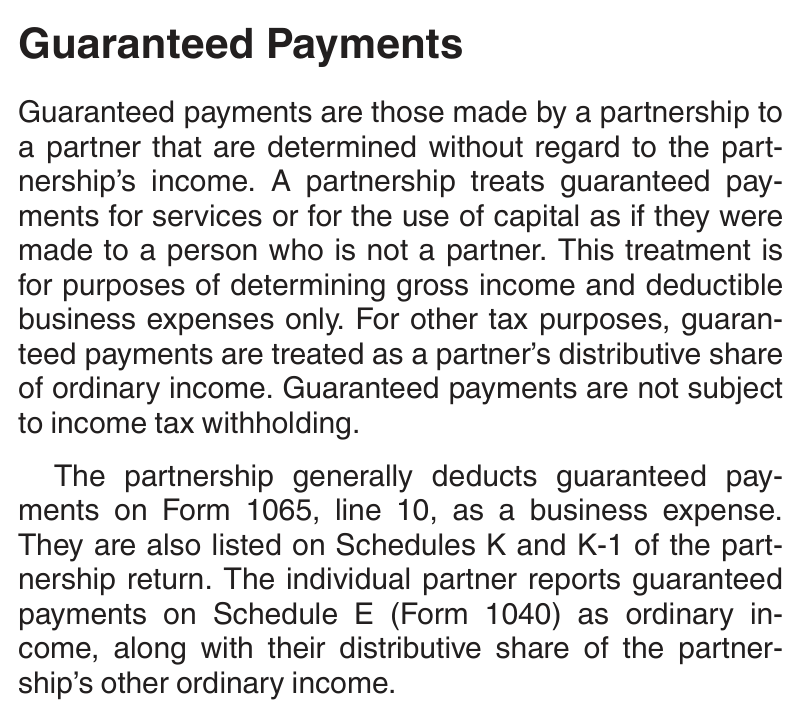
A guaranteed payment is determined without regard to partnership income and is made for services or the use of capital. A fixed payment for current services fits that description when the agreement gives the partner the amount whatever the profit.
Check the wording closely. A fixed payment plus a profit share differs from a guaranteed minimum, which may produce only a payment for a shortfall.
These federal rules apply to ordinary US partnerships, including LLCs taxed as partnerships. Corporations, LLCs with a different tax election, foreign partners and special partnership regimes need their own analysis.
Sources and context, checked :
Three items, three treatments
Partners are not employees in their partner role and should not receive a Form W-2. Guaranteed payments are not subject to income tax withholding, but that does not make them tax-free. The income belongs to the partner's tax year in which the partnership's tax year ends.
The table shows the ordinary treatment for current service payments. Payments for organizing a partnership or for syndication need a capitalization analysis.
| Item | What identifies it | Ordinary federal treatment |
|---|---|---|
| Guaranteed payment | Set without regard to partnership income | Generally a deductible business cost and ordinary income to the partner, reported through Form 1065, Schedule K-1 and generally Schedule E |
| Profit allocation | The agreement's profit-share formula | The partner's distributive share of income, passed through on Schedule K-1 |
| Cash distribution | Cash withdrawn, including in anticipation of earnings | Does not determine the distributive share and generally reduces outside basis |
Sources and context, checked :
A hypothetical income and cash bridge
This hypothetical uses a calendar-year domestic operating partnership and an individual US partner. The service costs are current and meet the deduction rules. The agreement gives the partner a fixed $24,000 service payment, independent of income, plus 25% of ordinary profit after that payment. Profit before the payment is $80,000. The $24,000 is paid in the year, and a separate $10,000 cash distribution is made. Outside basis is sufficient. There are no separately stated items, losses, capitalization, retirement, disguised-sale, distribution-exception or debt-change complications.
The example is a fixed payment plus a profit share, not a minimum-profit guarantee. It does not compute self-employment tax, estimated tax, loss limits or a personal tax bill.
Profit after the payment is $80,000 less $24,000, or $56,000, and the partner's 25% share is $14,000. The $38,000 of income in the table comes before individual adjustments and tax computations. The $10,000 distribution is not a second partnership expense, and it does not replace the $14,000 profit allocation.
| Item | Partner ordinary income | Cash received |
|---|---|---|
| Fixed guaranteed payment | $24,000 | $24,000 |
| 25% profit allocation | $14,000 | $0 |
| Cash distribution | $0 | $10,000 |
| Total | $38,000 | $34,000 |
Partner file and basis checks
A cash distribution generally reduces outside basis, and cash above that basis can cause gain, subject to exceptions. Outside tax basis and book capital are different measures, so the capital account in the ledger does not answer this question.
Ask one question of every amount paid to a partner: which term of the agreement entitles them to it? If nobody can point to one, resolve that before the amount is coded.
- Keep the signed agreement, including the payment entitlement and the profit-share formula.
- Separate service payments, profit allocations, distributions, contributions and expense reimbursements.
- Reconcile each partner's bank receipts to the Schedule K-1 categories.
- Maintain a separate outside-basis check for distributions.
Sources and context, checked :