
Partnership cash distributions: check outside basis before calling them tax-free
Hypothetical situation: a partner receives $12,000 in cash from a partnership while the capital account shows only $10,000. One instinct says the extra $2,000 must be taxable. Another says a payment below the capital balance is always tax-free. Neither conclusion follows from the capital account. Under the general federal rule, gain on a cash distribution depends on the partner's outside basis immediately before the distribution, and a change in the partner's share of partnership liabilities can move that basis or count as money in its own right. This article covers ordinary cash distributions, not payments for services, property distributions or sales of an interest.
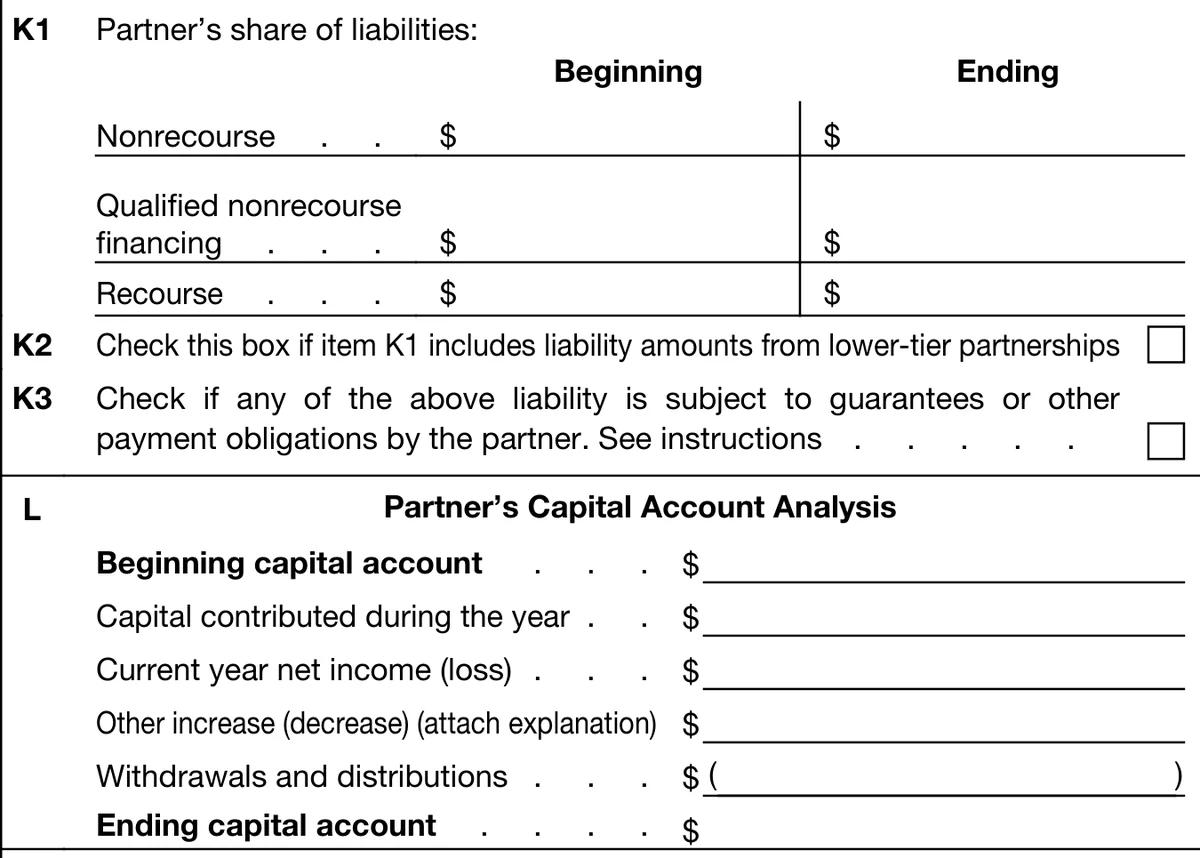
Outside basis is not the capital account
IRS Publication 541 describes outside basis as the adjusted tax basis of the partner's interest. It differs from inside basis, which is the partnership's basis in its own assets, and from book capital. The publication says the book capital or equity account does not determine outside basis.
The Partner's Instructions for Schedule K-1 (Form 1065) make the same practical point: item L, the capital account analysis, cannot by itself calculate adjusted outside basis. The partner keeps their own basis calculation. Contributions, allocated taxable and tax-exempt income, distributions, losses and nondeductible expenses may all affect it.
Sources and context, checked :
How liabilities and cash move basis
Publication 541 explains that an increase in a partner's share of partnership liabilities generally acts as a contribution of money, raising outside basis. A decrease generally acts as a distribution of money. The share has to follow the tax allocation rules; dividing total debt by ownership percentages is not always correct.
Cash distributions generally reduce outside basis, but not below zero. Money that exceeds adjusted basis immediately before the distribution generally creates gain. Marketable securities and liability decreases can count as money under separate rules.
The 2025 K-1 instructions separate item K1 liabilities, item L capital and box 19 distributions. They warn that some transactions need a basis calculation at a specific point in time rather than only the annual worksheet order. Treat that edition as an illustration of the reporting, not as instructions for a 2026 return.
Sources and context, checked :
Two hypothetical outcomes
Hypothetical: a partner has $10,000 of tax-basis capital and a valid $5,000 share of partnership tax liabilities. These are the only differences, so outside basis immediately before the distribution is $15,000. There is no income, loss, nondeductible item, security, contributed-property rule, unrealized receivable or inventory effect. The two columns below are independent alternatives.
With liabilities unchanged, $12,000 of cash is below the $15,000 outside basis, so there is no distribution gain under the general rule, even though the capital account showed only $10,000. If the same distribution also cuts the liability share to zero with no offsetting increase, the $5,000 decrease is deemed money, total money is $17,000 and the $2,000 excess is generally gain. Special rules can change both gain and character, so that excess should not be labelled capital gain automatically.
| Step | Liabilities unchanged | Liability share falls to zero |
|---|---|---|
| Outside basis before distribution | $15,000 | $15,000 |
| Cash distributed | $12,000 | $12,000 |
| Deemed money from liability decrease | $0 | $5,000 |
| Total money | $12,000 | $17,000 |
| Excess over outside basis | $0 | $2,000 |
| Outside basis after distribution | $3,000 | $0 |
Prepare the basis support
Before a distribution is described as tax-free in the schedule sent to the return preparer, assemble the following.
- A supported opening outside basis, not just the current year's item L.
- Contributions, allocated income, tax-exempt income, nondeductible costs and earlier distributions since that opening figure.
- The partner's liability share immediately before and after the distribution, with the basis for the allocation.
- The bank record, partnership authorization and K-1 reporting for the cash paid.
When to stop and escalate
Flag distributions involving property, securities, unrealized receivables or inventory, contributed property or a redemption for separate review, because the general rule above may not apply. This check also does not decide whether the partner can deduct losses under the at-risk or passive activity rules.