
How the 12-month rule affects business rent paid in advance
For an ordinary US federal cash-method Schedule C business, advance rent on business premises is sometimes deductible in the year paid and sometimes spread over the period it covers. The first test is the 12-month rule, which addresses whether the payment must be capitalized. It applies only when the benefit paid for ends no later than the earlier of 12 months after it begins or the end of the tax year after the year of payment. Passing it does not by itself guarantee an immediate deduction, because other deduction rules and any capitalization election also matter. A prepayment that runs past either cutoff is deducted over the period it applies to, and either way the business must apply its accounting method consistently.
Test the 12-month rule first
The capitalization regulations contain a 12-month rule. It removes the requirement to capitalize a payment for a right or benefit that extends no later than the earlier of two dates: 12 months after the benefit first begins, or the end of the tax year following the year of payment. Both cutoffs apply, and the earlier one controls.
The current regulation illustrates this with prepaid office rent. Example 10 in paragraph (f)(8) contrasts an accrual-method business with a cash-method business, and on its stated assumptions the cash-method business's rent qualifies for the 12-month rule. Example 2 in paragraph (d)(3) supplies the contrast of a longer advance rent payment. Publication 538 explains the same general rule and 12-month exception for expenses paid in advance.
Passing the 12-month rule does not settle every deduction question. The regulation coordinates the rule with other provisions, and the payment still has to meet the other requirements for deducting rent.
When rent is spread over the period it covers
Publication 334 for 2025, in chapter 8, Rent Expense, gives the general rule: rent paid in advance is deductible only to the extent it applies to use of the property during the tax year, and the rest is deductible over the period to which it applies. The IRS made the same point in Tax Tip 2022-37, published on 3 March 2022. That short passage is not exhaustive. Read it alongside the 12-month rule and accounting method rules, and do not treat it as ruling out the exception.
Before timing anything, confirm the payment is deductible rent. Rent is generally a business expense only for property used in the business, and payments for property in which you have or will receive equity or title do not count as rent for this purpose. Unreasonable rent paid to a related party and business use of your home follow separate rules. Refundable security deposits, lease-purchase arrangements, section 467 rental agreements and long-term or stepped-rent leases each need their own analysis.
Sources and context, checked :
Hypothetical example: 24 months paid on 1 December
Hypothetical: an ordinary calendar-year sole proprietor using the cash method pays $24,000 on 1 December 2026 for premises used entirely in the business. The lease covers December 2026 through November 2028, 24 months at an even $1,000 a month. Assume the rent is otherwise deductible, the business applies a proper method consistently, and there is no refundable deposit, personal use, equity or title interest, section 467 arrangement or other special lease term.
The benefit begins on 1 December 2026 and lasts 24 months. That extends beyond 12 months and beyond 31 December 2027, the end of the following tax year, so the 12-month rule does not apply. The rent is allocated to the tax years in which the premises are used.
| Tax year | Months of use | Rent allocated |
|---|---|---|
| 2026 | December 2026 | $1,000 |
| 2027 | January through December 2027 | $12,000 |
| 2028 | January through November 2028 | $11,000 |
| Total | 24 months | $24,000 |
Apply your accounting method consistently
Publication 538 says that changing the existing treatment of an expense may require IRS approval. Paragraph (f)(7) of the current regulation also permits an election to capitalize instead of applying the 12-month rule, covering all similar transactions in the taxable year and subject to its revocation rules. Before changing how similar prepayments are treated, check the existing method, any capitalization election and any required IRS approval.
This article does not assess the procedure for requesting a method change or any adjustment that comes with one.
Sources and context, checked :
Book schedules, Schedule C and records
In the books, a prepaid rent schedule would release $1,000 to expense in each of the 24 months. In this hypothetical the tax allocation follows the same monthly arithmetic, yet the two answers come from different rules. For a shorter prepayment that qualifies under the 12-month rule, the tax deduction and the book expense can fall in different years. Keep separate workpapers, so a change to the book schedule does not quietly rewrite the tax treatment.
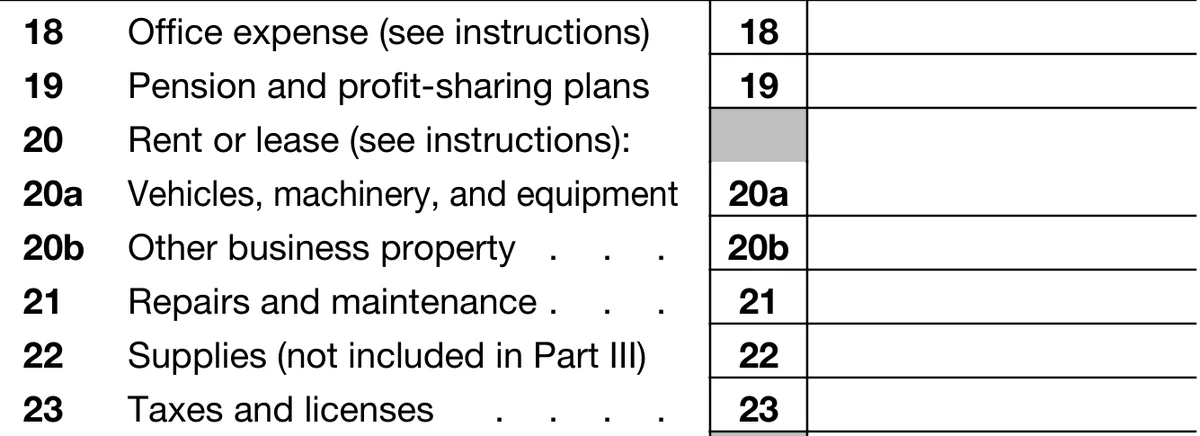
The source image for this article uses line 20b of the 2025 Schedule C, rent or lease of other business property, to illustrate where premises rent is reported. A reporting line shows where an allowable amount goes. It does not decide timing or how much is allowable.
Keep these records with the return file:
- The lease or invoice showing the exact period the payment covers
- Proof of payment and its date
- A 12-month rule workpaper showing the benefit start date and both cutoff dates
- The tax-year allocation, where the rule does not apply
- A note of how earlier advance rent payments were treated
- Notes confirming there is no deposit, equity or title arrangement, personal use or special lease term
Sources and context, checked :