
US home-office deductions: compare the methods after checking the space
A self-employed Schedule C filer works from a 200-square-foot room in a rented home. Under US federal rules, the simplified method gives a $1,000 deduction before the income limit, while the actual-expense method gives $2,100 on the assumed figures. Neither calculation makes the room eligible. The space must qualify first, and the larger figure is only the start of the comparison.
Check the space first
The ordinary home-office case requires regular and exclusive use, commonly as the principal place of business. A home used for administrative or management work can qualify as the principal place if no other fixed location is used for substantial work of that kind. Storage and daycare have separate exceptions. A kitchen table also used personally normally fails the exclusive use test.
Sources and context, checked :
How the methods differ
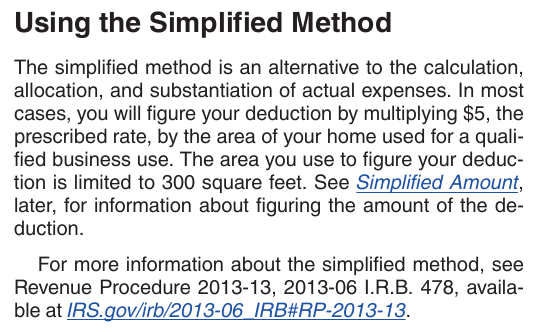
The simplified method changes the calculation, not the eligibility test. It uses $5 per allowable square foot, limited to 300 square feet. That is a maximum of $1,500 before the income limit, which caps the deduction at gross income from the qualified use minus business deductions unrelated to the home.
The actual method allocates costs between business and personal use. Indirect costs generally use the business percentage, while direct costs for the business space may be fully allocable. Schedule C filers use Form 8829 for this method. Costs unrelated to the home, such as business supplies, stay separate under either method.
Part-year use or a change in area needs more work under the simplified method. It uses average monthly allowable area, counting zero for any month with fewer than 15 days of qualifying use.
| Issue | Simplified method | Actual expenses |
|---|---|---|
| Home depreciation | Deemed zero for the year | Owners must address depreciation and its later basis and sale effects; renters have none |
| Other home costs | No actual home-use expenses deducted as business expenses that year; otherwise allowable personal deductions follow their own rules. | Allocated and supported by records |
| Amount over the income limit | Disallowed amount does not carry forward | Eligible disallowed home-use expenses carry forward, subject to the applicable limits; they cannot be claimed in a simplified-method year. |
| Earlier disallowed actual expenses | Cannot be deducted in a simplified year | Can be considered in an actual-expense year |
A hypothetical full-year renter
Assume one Schedule C business and a qualifying office used regularly and exclusively for the whole year. The office is 200 square feet in a 2,000-square-foot home. Annual rent is $18,000, and eligible whole-home utilities and insurance total $3,000. There are no direct expenses, depreciation, carryovers or casualty losses, and income is high enough to permit either result.
The business percentage is 200 ÷ 2,000 = 10%. The simplified calculation is 200 × $5 = $1,000. The actual calculation is ($18,000 + $3,000) × 10% = $2,100. The difference in deductions is $1,100, which is not $1,100 of tax savings.
On these facts, the actual method produces the larger deduction if the records support it. An owner would also need to weigh depreciation and a later sale, and a filer with less income or existing carryovers could reach a different answer. A move or change in the space would need a different calculation.
Compare before filing
The filer chooses the simplified method on a timely filed original federal income tax return. That choice is irrevocable for the tax year, although a later year may use the other method without an accounting method change. The same method applies to all qualified business uses of that home.
This example covers a self-employed individual for federal purposes only. Employee, corporate reimbursement, rental property and state tax questions need separate review. Before filing, these steps keep both options open:
- Record the measurements, dates and how the space is used.
- Keep the actual-expense file even if the simplified method looks likely.
- Compare both calculations, any carryovers and the effects of owning or renting.
Sources and context, checked :