
Qualified improvement property: split the fit-out before choosing recovery
Hypothetical: a company completes a $140,000 fit-out in a commercial building and codes the whole invoice as leasehold improvements. Some of the work builds out offices inside the building. Some adds floor space and installs an elevator. For US federal tax, those parts may not belong in the same class. This article assumes the costs are already capitalized and covers only separating qualified improvement property, or QIP, from excluded work. It does not decide repairs, book depreciation or state treatment.
What counts as qualified improvement property
Section 168(e)(6) defines QIP as an improvement the taxpayer makes to an interior portion of a building that is nonresidential real property, placed in service after the date the building was first placed in service. Buying an improvement someone else already made does not by itself make it the taxpayer's improvement. Publication 946 (2025) explains the same definition. The statute cited is current through Public Law 119-134 of 20 October 2026.
The lease label does not settle the class. Section 168(i)(8) applies the depreciation rules to improvements to leased property without regard to the lease term, so a short remaining lease does not set the tax recovery period.
Sources and context, checked :
Three exclusions
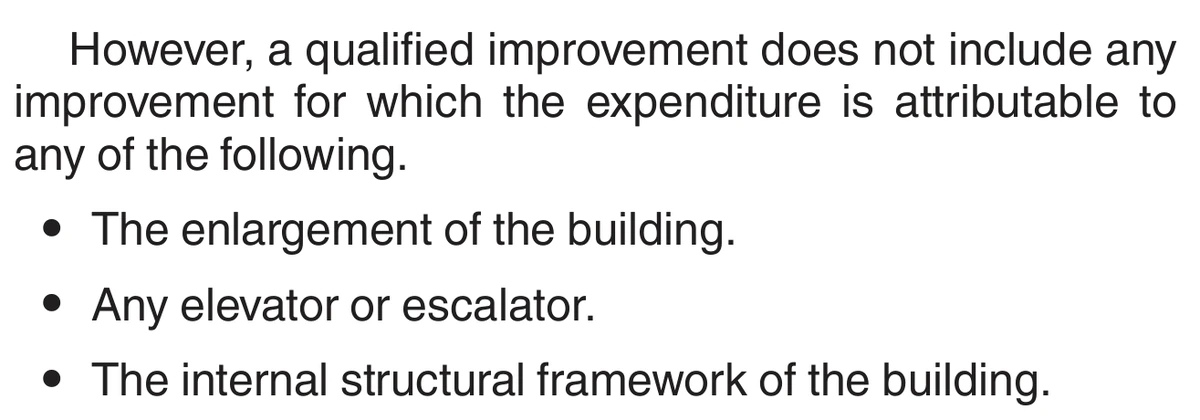
The definition excludes costs attributable to enlarging the building, any elevator or escalator, and the internal structural framework. Work is not QIP simply because it happens inside the walls. When one contractor invoice covers several kinds of work, the cost needs to be broken out before any of it is classified.
Sources and context, checked :
A hypothetical split
This is an original hypothetical cost-classification example, not a depreciation calculation. Assumptions: the commercial building was first placed in service in 2020, and the taxpayer's project is placed in service in October 2026. All $140,000 is separately documented, capitalized work made by the taxpayer, with no routine repairs, removable equipment, residential use, landlord incentives or allocation disputes. The itemized costs show $90,000 of interior nonstructural work that meets the definition and no exclusion, $20,000 of elevator work and $30,000 of building enlargement.
Coding the full $140,000 as QIP because the contractor called it a fit-out would misclassify $50,000. Each excluded component needs its own applicable tax treatment, which this example does not decide.
| Item | Calculation | Amount | Classification under assumed facts |
|---|---|---|---|
| Interior nonstructural work | Itemized cost | $90,000 | QIP |
| Elevator work | Itemized cost | $20,000 | Excluded from QIP |
| Building enlargement | Itemized cost | $30,000 | Excluded from QIP |
| Outside QIP | $20,000 + $30,000 | $50,000 | Needs separate treatment |
| Total reviewed | $90,000 + $20,000 + $30,000 | $140,000 | Ties to capitalized cost |
Sources and context, checked :
Classification comes before recovery
Under the general MACRS rules, QIP is 15-year property under section 168(e)(3)(E)(vii) and uses the straight-line method under section 168(b)(3)(G). The alternative depreciation system in section 168(g) and expensing rules can change the actual recovery. Classifying the $90,000 as QIP does not by itself establish a first-year write-off, and an asset required to use the alternative system does not use the 15-year general-system period.
- Keep project scope, drawings and itemized contractor costs, including the elevator, structural and enlargement amounts.
- Document the building's original placed-in-service date separately from this improvement's date.
- Establish who made the improvement for tax purposes and record each tax asset class.
- Only then review general or alternative system, conventions and any available elections with the return preparer.
Sources and context, checked :
Where to start
Ask the contractor for a cost breakdown that matches the three exclusions before the asset is set up. A split made at invoice time is easier to support than one reconstructed when the return is prepared.
Sources and context, checked :