
Related-party accruals: match the tax deduction to the payee's income
Hypothetical: a C corporation accrues December rent owed to its sole shareholder and pays it in February. The books correctly show the expense in December. For US federal income tax, the deduction may have to wait until the shareholder includes the rent in income. This article covers section 267(a)(2) timing for a domestic accrual-method C corporation and a cash-method individual owner. It does not cover pass-through special rules, foreign payees, financial statement tax accounting or the owner's own return.
The matching rule
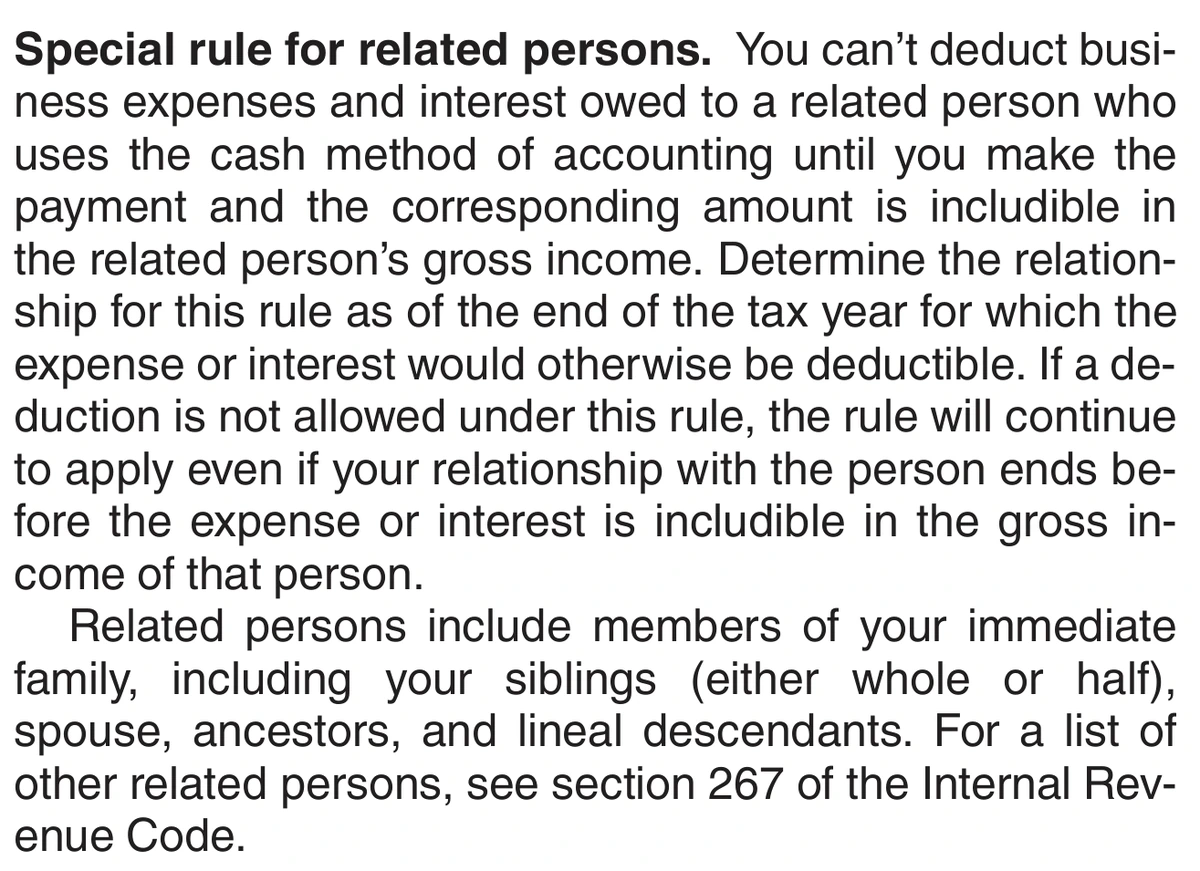
Section 267(a)(2) applies when the payee's accounting method means an amount is not includible in the payee's income until paid, and the payer and payee are related under section 267(b) at the close of the payer's tax year. An otherwise allowable deduction for the expense or interest is then allowed as of the day the amount is includible in the payee's gross income, or later if another rule delays it. The statute cited is current through Public Law 119-134 of 20 October 2026.
Publication 334 (2025) illustrates that the relationship is tested at that year-end. Ending the relationship before payment does not undo a deferral already imposed.
Sources and context, checked :
Testing the relationship
For an individual and a corporation, section 267(b)(2) asks whether the individual owns more than 50 percent in value of the outstanding stock, directly or indirectly. The attribution rules in section 267(c) count toward that test. S corporations and partnerships face additional rules in section 267(e), so 50 percent is not a universal threshold.
Sources and context, checked :
What the rule does not decide
The section 267(a)(2) matching rule governs timing. It does not create a liability, establish that the rent is reasonable or ordinary, or decide whether a cost must be capitalized. Those questions still need answering on their own, and an amount that fails them is not rescued by the matching rule.
Sources and context, checked :
A hypothetical rollforward
This is an original hypothetical tax-timing rollforward. Assumptions: a domestic, calendar-year, accrual-method C corporation owes its 100 percent individual shareholder $12,000 of fair ordinary business rent for December 2026 under a genuine, enforceable lease. The shareholder is domestic, calendar-year and cash-method. Nothing is paid, constructively received, offset, set aside or available to draw in 2026. All other deductibility requirements are met. The corporation pays on 15 February 2027, the owner includes $12,000 in 2027 gross income, and no other rule delays the deduction.
Under these facts, paying before the 2026 return is filed does not move the deduction back to 2026, and relabeling the ledger account changes nothing. The February payment clears the existing payable; it is not a second rent expense.
| Point in time | Book entry | Federal tax treatment | Amount |
|---|---|---|---|
| 2026 | Rent expense and payable recorded | Added back; deduction deferred | $12,000 |
| 31 December 2026 | Payable open | Deferred deduction carried forward | $12,000 |
| 15 February 2027 | Cash paid, payable cleared, no new expense | Deduction released in 2027 | $12,000 |
| 31 December 2027 | No balance | No deferred amount | $0 |
Sources and context, checked :
Keeping the schedule
A separate tax schedule stops the deferral from being lost or claimed twice.
- Match unpaid year-end expenses to ownership, family and attribution records, and document the relationship as of the payer's year-end.
- Confirm the payee's accounting method and whether the amount is already includible, including constructive receipt questions.
- Track opening deferral, additions, settlements and closing balance, with the accrual year and the payment or income year for each item.
- Release each tax adjustment once, on the supported matching date, and let the payment clear the book liability.
Sources and context, checked :
At the next year-end close
Sort the unpaid accruals list by payee before preparing the tax computation. Any amount owed to an owner or connected person is a prompt to check the relationship and the payee's method before the deduction is claimed.
Sources and context, checked :