
Cash-method inventory: keep the cost-of-goods trail
A calendar-year reseller pays a supplier $6,000 on 15 December 2026 for 100 units, provides 40 to customers before year end and provides the rest in January. The business uses the cash method, so the whole payment can look like a 2026 cost. Cash-method status does not decide that. The answer depends on whether the business qualifies for the small-business inventory rules and which inventory method it has adopted.
Check eligibility for 2026
For tax years beginning in 2026, the gross receipts test is met when average annual gross receipts over the preceding three tax years do not exceed $32 million. Revenue Procedure 2025-32, section 4.30, sets that amount. Use it rather than a figure from a guide written for 2025 returns.
The dollar test does not settle eligibility alone. Section 471(c) also excludes tax shelters prohibited from using the cash method. Eligibility is not limited to corporations and partnerships, and aggregation of related businesses and special rules for short or new tax years can matter.
Sources and context, checked :
Know which method applies
A genuine expensing method under the books-and-records alternative may produce a different result from NIMS. Inventory records kept for creditors or shareholders can matter, and a payment alone does not justify overriding those records.
Eligible businesses have more than one option, and those options do not all produce the same timing.
| Method | Basic position |
|---|---|
| Non-incidental materials and supplies (NIMS) | Cost is recovered through cost of goods sold in the later of the year the goods are provided to customers and the year the cost is paid or incurred under the overall accounting method |
| Applicable financial statement (AFS) | A method available to a business with an applicable financial statement |
| Non-tax books and records | An alternative for a business without an AFS, based on its genuine non-tax books and procedures |
Sources and context, checked :
A hypothetical December purchase
In this hypothetical, the business qualifies for section 471(c) in 2026, is not a tax shelter and has already properly adopted NIMS. It buys 100 identical units at $60 each and has no opening inventory, freight, returns, personal withdrawals, obsolescence, unpaid balance or other acquisition costs.
Under this stated method, the December payment does not make the full $6,000 a 2026 cost of goods sold. Payment timing can also delay recovery. If the 40 delivered units had not been paid for until 2027 under the cash method, their cost would also wait until 2027. The result is specific to these NIMS facts and is not the universal result under every section 471(c) alternative.
On the stated facts, the cost trail splits as follows.
| Units and cost | Paid | Provided to customers | Cost recovery |
|---|---|---|---|
| 40 units, $2,400 | 15 December 2026 | Before 31 December 2026 | 2026: $2,400 |
| 60 units, $3,600 | 15 December 2026 | January 2027 | 2027: $3,600, unrecovered at 31 December 2026 |
| 100 units, $6,000 | 15 December 2026 | 40 in 2026, 60 in 2027 | 2026: $2,400; 2027: $3,600 |
Records and method changes
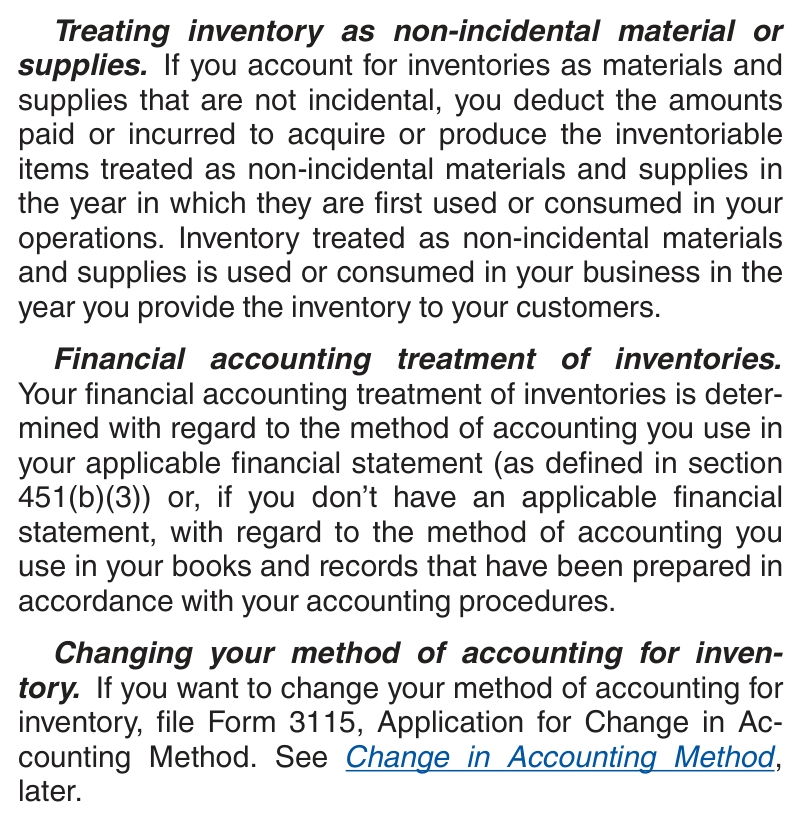
NIMS does not remove the need for stock and cost records. Changing inventory treatment is also more than a year-end relabeling journal. It is an accounting method change that requires consent and the applicable procedures, generally involving Form 3115. Book inventory valuation, manufacturing cost allocation and state income tax are separate questions.
Under the hypothetical method, the useful closing figure is the unrecovered cost: $3,600. If the records cannot produce that figure, fix the trail from supplier payment to customer delivery before relying on any cost of goods sold number.
- Confirm the tax year, prior three-year receipts, related-business aggregation and tax-shelter status.
- Save the adopted inventory method and, for the books-and-records alternative, evidence of the non-tax procedures.
- Reconcile purchase costs, payment dates, units provided to customers and unrecovered closing costs.
- Send proposed method changes to the return preparer before posting them.
Sources and context, checked :