
Sole proprietor draws: personal spending does not reduce profit
Code each payment by what it bought, not by the account that paid it. A transfer to your personal account and groceries on the business debit card are draws, so neither reduces Schedule C profit. A substantiated business cost you paid from a personal account can still be a business expense.
Why an owner's pay is not an expense
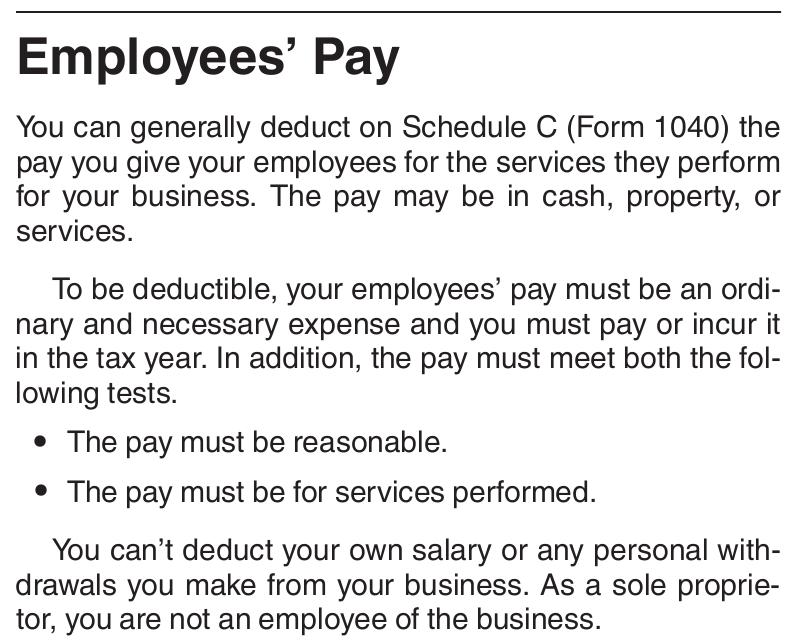
A sole proprietor is not their business's employee. Publication 334 says you cannot deduct your own salary or personal withdrawals, so naming a monthly transfer owner salary changes nothing. A drawing account records business income you withdraw for personal or family expenses.
Net profit is business income minus business expenses, and taking a draw does not determine that figure. Taking no draw does not remove tax on the profit either. These rules apply to a Schedule C sole proprietor. Corporate shareholder loans, payroll, dividends and partnership distributions are outside this guide.
Sources and context, checked :
Start with what was bought
Publication 334 tells you to separate business from personal expenses. Personal, living and family costs generally cannot be deducted. If a cost is genuinely part business and part personal, split it, so a mixed-use item does not go wholly to drawings.
A cost the owner pays personally gets the same test. Schedule C reports the proprietor's business income and expenses, and substantiated ordinary and necessary costs are classified by their nature, subject to capitalization and other limits where relevant. Paying from a personal account does not disqualify a cost, and it does not qualify one either.
Sources and context, checked :
Three hypothetical payments
Before these items, revenue is $30,000 and valid business expenses are $12,000. The $400 of supplies is fully substantiated, ordinary and currently deductible under the business's applicable method.
Profit is $30,000 minus $12,000 minus $400, or $17,600. Drawings total $5,300 and owner funding is $400.
Running groceries through the business bank does not make them deductible, and paying for supplies personally does not stop them being a business cost. These classifications are our illustration, not an IRS journal format.
| Payment | Paid from | Classification | Effect on profit | Owner account |
|---|---|---|---|---|
| $5,000 transfer to personal account | Business bank | Drawing | None | $5,000 drawn |
| $300 household groceries | Business debit card | Drawing | None | $300 drawn |
| $400 business supplies | Personal account | Business expense with owner funding | Down $400 | $400 funded |
Merchandise is a separate case
Goods taken from stock follow their own entry. Publication 334 says to remove the cost of merchandise withdrawn for personal use from purchases and charge the drawing account. This is an inventory issue, not cash salary. No cash moves, so the bank feed will not prompt you to record it.
Sources and context, checked :
Reconcile the owner accounts separately
We suggest reviewing owner draws and funding apart from the Schedule C profit schedule, using these steps.
- Find the receipt and business purpose before assigning an expense code.
- Move wholly personal payments to the owner-draw account.
- Record each personally paid business cost once, with its evidence and an owner-funding entry. A later repayment to the owner is not a second expense.
- Apply the normal deduction, capitalization and mixed-use rules to the underlying cost.
What to fix at the next close
Search the expense ledger for anything labelled owner pay, salary or personal, then check each item against its receipt. In the example, profit stays at $17,600 whether the owner draws $5,300 or nothing, so plan for tax from the profit figure and not from the amount taken out.