
Defined contribution pensions: service cost before cash payment
An employer's pension schedule shows £3,600 of contributions for employees' 2026 service, but only £3,300 paid to the plan during the year. There was also £400 owed at the start. Expense of £3,300 would follow the bank and miss part of the service cost. In this hypothetical genuine defined contribution plan under UK-adopted IAS 19, expense is £3,600 and the closing liability is £700. The difference can be explained only by bringing the opening balance into the reconciliation.
Confirm the promise is defined contribution
IAS 19 paragraphs 27 to 30 classify a plan by its economic substance and principal terms. In a defined contribution plan, the employer's legal or constructive obligation is limited to the agreed contributions. The fact that an employer pays a fixed sum each month does not establish that conclusion.
A guarantee or an informal obligation to provide further support can change the assessment. Read the benefit promise and scheme terms rather than relying on a payroll label. Defined benefit plans and special multi-employer situations require their own analysis.
This article covers employer contributions under a genuine defined contribution plan in UK-adopted full IFRS accounts. It does not set pension-law payment deadlines, auto-enrolment eligibility or contribution rates. Employee amounts withheld from wages are separate from the employer's expense.
Sources and context, checked :
Recognise the contributions for service
Paragraph 51 recognises the contributions payable for employees' service as a liability after deducting amounts already paid. The corresponding cost is an expense unless another IFRS requires or permits it to be included in an asset's cost. A later remittance date does not move the service into a later expense period.
For defined contribution plans, paragraph 50 does not require actuarial assumptions or actuarial gain-and-loss calculations to measure the obligation. Contributions are normally undiscounted within the specified settlement window. If contributions are not expected to settle wholly before twelve months after the end of the annual period in which the service was rendered, paragraph 52 requires discounting using paragraph 83's rate.
Sources and context, checked :
Bridge service cost to the £700 payable
Assume actual scheme terms produce £3,600 of employer contributions for 2026 service. None is included in an asset's cost. The opening liability is £400 and £3,300 remitted during 2026 settles opening and current obligations. There are no refunds, adjustments or employee-withheld contributions in this schedule, and the remaining liability settles shortly after year end.
Record current service as Dr employer pension expense £3,600; Cr pension payable £3,600. Record remittances as Dr pension payable £3,300; Cr bank £3,300. The £400 opening liability is already in the ledger; adding it as another current-year expense would count earlier service twice.
The £700 closing liability is £400 + £3,600 - £3,300. It is neither the £300 difference between this year's expense and cash nor another £700 expense to add after posting the service contributions.
| Employer contribution payable | Amount |
|---|---|
| Opening liability | £400 |
| Contributions for 2026 service | £3,600 |
| Remittances to plan | (£3,300) |
| Closing liability | £700 |
Sources and context, checked :
An overpayment needs evidence of recovery
Consider a separate example with no opening balance. Contributions for past service are £3,600 but the employer has paid £3,900. Paragraph 51 recognises the £300 excess as a prepayment only to the extent it will reduce future payments or produce a cash refund. A bank overpayment alone does not prove a recoverable asset.
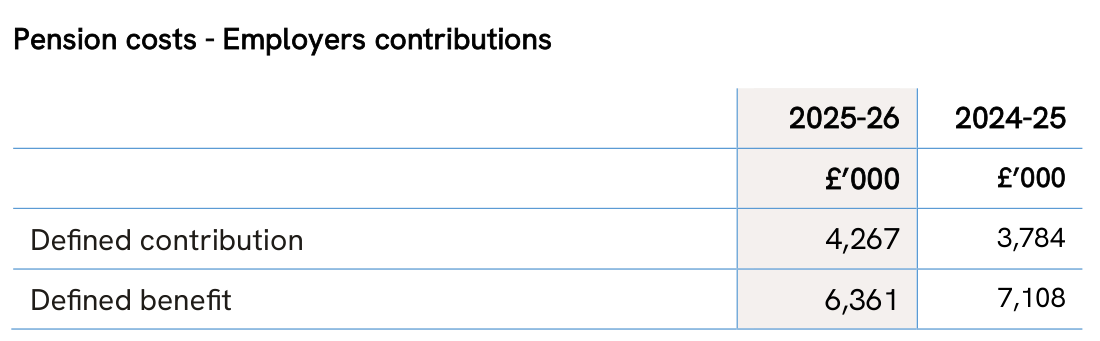
Ordnance Survey's 2025/26 policy for its Horizon defined contribution scheme says cost follows contributions payable for the year, with differences from cash treated as accruals or prepayments. That published policy illustrates the distinction. It does not supply the company's cash remittances or closing pension payable.
Tie the scheme to payroll and the plan statement
Keep the scheme terms, employer-contribution reports and plan remittance statements together. Confirm the classification, tie contributions for the service period to expense or qualifying asset cost, and reconcile the opening liability through evidenced payments to the closing balance. Reconcile employee deductions separately so they are not added as another employer cost.
IAS 19 paragraphs 53 and 54 require disclosure of the amount recognised as defined contribution expense. Use the service-cost total for that work, rather than substituting cash paid. Investigate a difference by tracing the opening balance and settlement evidence before posting an extra expense.
Sources and context, checked :