
Unused holiday pay: accrue leave employees have already earned
An employee earns five days of leave before 31 December and takes them in February. The work that earned those days happened this year, so under IAS 19 as adopted in the UK the cost belongs this year too, provided the leave is accumulating: unused entitlement carries forward and can be used later. The liability builds as employees render the service that increases their entitlement to future paid absence. The fact that unused days would not be paid in cash when someone leaves does not by itself remove the obligation.
Accumulating or not
IAS 19 treats paid leave as a short-term employee benefit when it is expected to be settled wholly before twelve months after the end of the annual reporting period in which employees render the related service. The amount is undiscounted, net of anything already paid, and is normally an expense unless another standard includes it in the cost of an asset (IAS 19, paragraphs 8 to 11). Leave not expected to be settled within that window needs a separate assessment as another long-term benefit.
For accumulating paid absences, the expected cost is recognised as employees render service that increases their entitlement. For non-accumulating absences, it is recognised when the absence happens (paragraphs 13 to 14). Accumulating rights carry forward. They may vest, so employees are paid for unused entitlement when they leave, or be non-vesting. A non-vesting right is still an obligation, though the possibility that employees leave before using it affects measurement (paragraph 15).
Measure the additional amount the entity expects to pay because of unused entitlement accumulated at the reporting date (paragraphs 16 to 18). IAS 19's sick-leave example shows why multiplying every unused day by a daily rate can overstate the obligation when no additional payment is expected. Non-accumulating days that simply expire are not accrued just because a leave tracker shows them. Read the scheme terms, because a label does not decide which kind it is. None of this sets out what UK employment law entitles employees to or what statutory holiday pay should be.
Sources and context, checked :
Three hypothetical employees
This example is hypothetical, in pounds. The days are earned accumulating leave, validly carried forward and expected to be taken as additional paid leave within the short-term period. None has been accrued elsewhere or paid. The daily figures are stipulated full employer costs for the example, not statutory holiday pay rates, and no further adjustment for employer costs, variable pay or forfeiture is needed on these facts.
The closing liability is 5 × £160 + 3 × £200 + 2 × £180 = £1,760. With no accrual already recognised, the journal is Dr leave expense £1,760, Cr accrued employee benefits £1,760. If the ledger already holds £1,400 for these same entitlements on the same basis, reconcile how that balance arose, then post only the £360 difference: Dr leave expense £360, Cr accrued employee benefits £360.
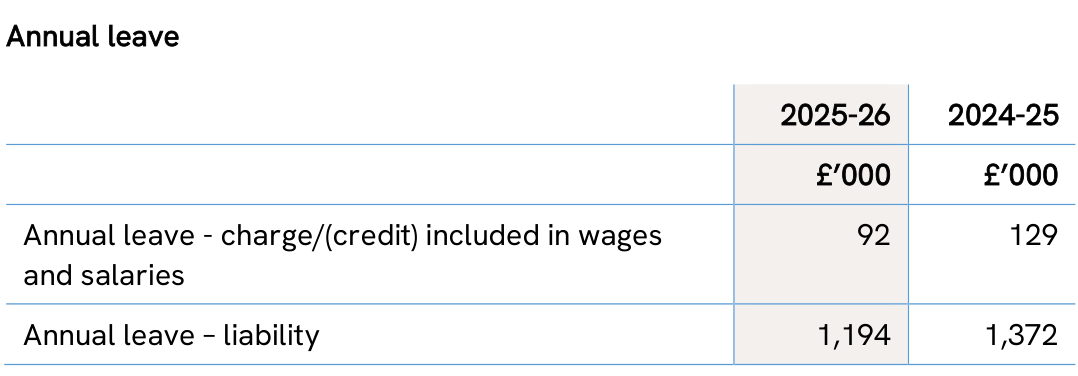
That £360 is the adjustment needed to reach the closing liability, not the year's holiday pay expense. Ordnance Survey's 2025/26 report shows the distinction in published form: an annual leave liability of £1.194 million and, separately, a £92,000 annual leave charge. The table alone does not explain the movement between its liabilities, so it shows that the two measures differ, not how to derive one from the other.
| Hypothetical employee | Earned unused days expected to be paid | Assumed daily employer cost | Closing liability |
|---|---|---|---|
| A | 5 | £160 | £800 |
| B | 3 | £200 | £600 |
| C | 2 | £180 | £360 |
| Total | 10 | Not one blended rate | £1,760 |
Sources and context, checked :
Reconcile from policy to ledger
We suggest starting with the employment terms and the leave policy actually applied: carry-forward, expiry, the order in which days are used, any payment on leaving and established practice. Do not assume entitlements the documents do not support. Obtain each employee's earned, used and carried-forward days at the reporting date, reconcile them to HR records and remove allowances for future periods not yet earned.
Estimate the additional paid absences expected and the daily employer cost on the scheme's facts, allowing for departures before use and expiry where they apply. Compare the result with the accrual already in the ledger, post only the movement and track usage and releases so the same cost is not charged twice. Record the expected settlement period, and flag any balance that could fall outside the short-term window.
At this year end
Ask HR for an earned-day report dated at the reporting date, put the policy terms beside it and reconcile the result to the accrual already in the ledger before posting anything.