
Canceled business debt: measure insolvency before the cancellation
If a lender forgives $15,000 of your sole proprietorship's loan principal, start by treating it as income. The insolvency exclusion can remove some or all of that amount, but only up to the amount by which your total liabilities exceeded the fair market value of all your assets immediately before the cancellation. A business that looks insolvent on its own balance sheet does not answer that question.
Where the income starts
The IRS says canceled debt is generally ordinary income unless an exception or exclusion applies. In the 2025 guidance, the latest final edition available, taxable canceled nonfarm sole proprietorship debt goes on Schedule C line 6. Check the instructions for the year of your cancellation.
Order matters. The Title 11 bankruptcy exclusion applies before insolvency, so rule that out and check for exceptions first. Separate principal from interest and unpaid operating bills too. For a cash-method debtor, forgiveness of a debt whose payment would have been deductible can fall within the deductible-debt exception, but loan principal is not that kind of expense.
This guide covers recourse business-loan principal owed by an individual Schedule C sole proprietor, with no property transfer and no bankruptcy. It does not cover partnerships, S corporations, farms, qualified real property business debt or foreclosures.
Test the individual, not the business
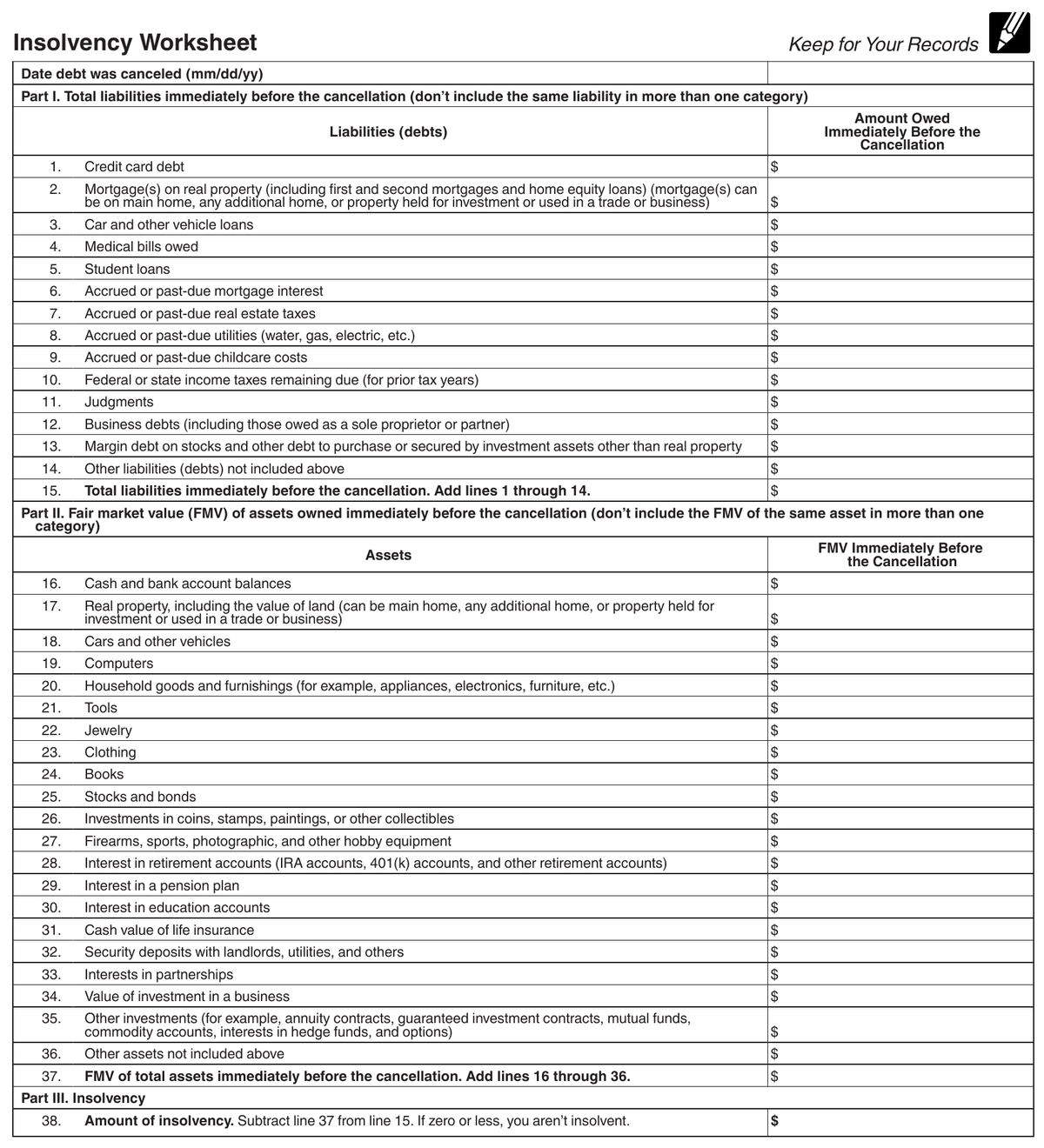
Publication 4681 defines insolvency as liabilities exceeding the fair market value of all assets immediately before the cancellation. Low cash does not meet that test. Neither does negative equity on the business books, and an insolvent disregarded business does not by itself make its individual owner insolvent.
The asset side is wide. Include personal assets, collateral and exempt assets such as retirement and pension interests. Leaving out a retirement account can make a solvent person look insolvent. Liabilities follow specific rules for recourse and nonrecourse debt, so check those before you total the schedule.
Sources and context, checked :
A partial exclusion, worked through
In this hypothetical, an individual sole proprietor has $15,000 of recourse business-loan principal canceled. There is no property transfer, accrued interest, bankruptcy, purchase-price adjustment or other exclusion, and all relevant liabilities are recourse.
The exclusion is limited to the lesser of the canceled debt and the insolvency amount, so $10,000 can be excluded and $5,000 remains taxable business cancellation income on these assumptions. The books still show the full $15,000 leaving the loan balance. Track the split in a separate tax reconciliation.
| Item | Amount |
|---|---|
| Liabilities immediately before cancellation, including the debt to be canceled | $100,000 |
| Fair market value of all assets immediately before cancellation | $90,000 |
| Insolvency amount | $10,000 |
| Canceled principal | $15,000 |
| Excluded under insolvency | $10,000 |
| Remaining income before any other rule | $5,000 |
Sources and context, checked :
What the exclusion costs later
Publication 4681 directs you to file Form 982, check line 1b and enter the excluded amount on line 2. The exclusion may also require tax-attribute reductions in Part II, which can affect losses, credits and asset basis. Topic 431 says excluded debt often requires this reduction, so the $10,000 in the example may leave you with smaller tax benefits later. State conformity and the full range of possible reductions sit outside this example.
The two schedules to keep
We suggest keeping two schedules. The first records what the lender released: the settlement agreement, the actual cancellation date and the split between principal, interest, unpaid deductible bills and any property. If you receive a Form 1099-C, reconcile it to those facts. A missing Form 1099-C does not mean you have no income from the release.
The second covers your position as an individual immediately before the cancellation. List every asset at fair market value and every liability at the amount owed under the applicable liability rules, with support for each figure.
Establish the actual cancellation date from the settlement terms and the facts of what happened before you value anything. The signature or agreement date alone does not fix it. Insolvency is measured immediately before the actual cancellation, so figures prepared for any other date measure the wrong moment.