
Form 1099-K reconciliation: count each payment once
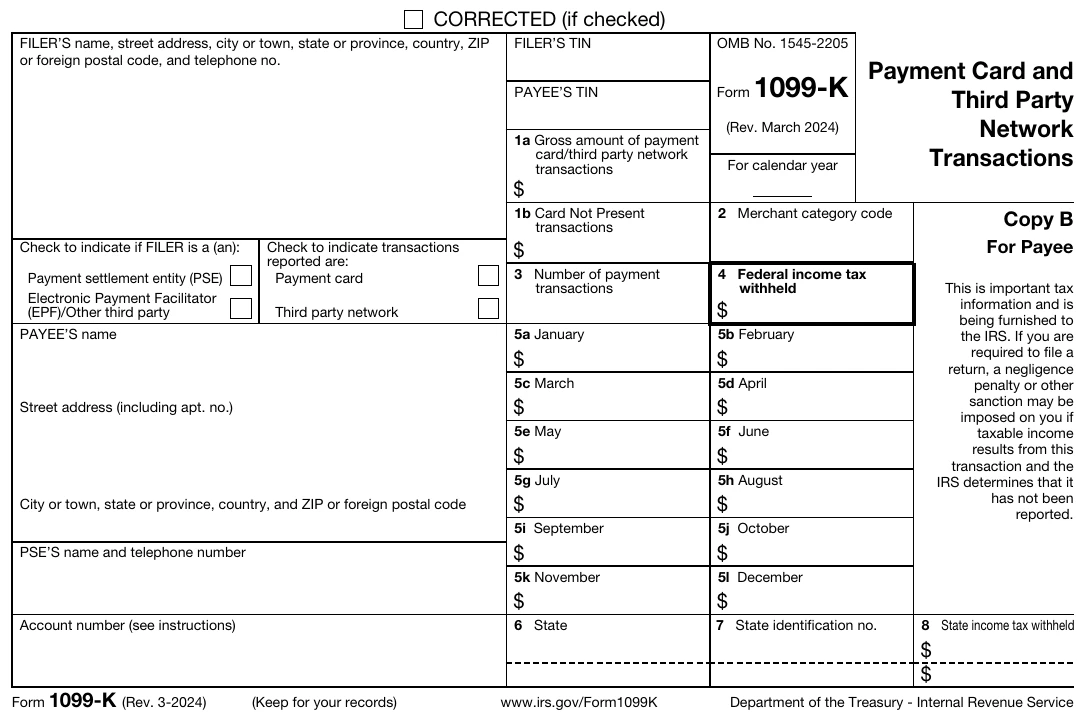
Two Forms 1099-K arrive for the same year, each showing $40,000 in box 1a. If both go into the income figure, the business reports $80,000 of payments that happened once. A US bookkeeper needs to check the information returns against the transaction records before the federal return is prepared. A 1099-K is third-party evidence of gross payments. It is not a sales entry, and it does not calculate taxable profit.
Who receives a form in 2026
The IRS treats two kinds of payment differently. Payment card transactions have no minimum reporting threshold. For third-party settlement organizations, the federal threshold is gross payments of more than $20,000 and more than 200 transactions. Both conditions must be met. Public Law 119-21 restored that threshold retroactively, so older material describing lower phased-in thresholds is out of date.
A threshold decides when an issuer must file the form, not whether income is taxable. A settlement organization may send a form below its threshold, and state reporting rules can differ from the federal ones.
Sources and context, checked :
Check whose form it is
Before comparing amounts, confirm the payee name and taxpayer identification number, the calendar year, the issuer and the transaction type on each form. These fields explain many apparent mismatches. A business that changed legal entity during the year, shared a card terminal, or bought or sold a business can receive a form that mixes payments belonging to different taxpayers.
Box 1a is the gross amount of reportable payments, before fees, refunds and other credits. The IRS points recipients to merchant and platform transaction reports, and their own receipts, rather than bank deposits alone. A correct form can exceed deposits because fees were deducted, refunds were issued or funds were held back. It can also be lower than total business receipts when some customers paid in cash or by other means. A gap between gross and deposited amounts is not, on its own, an error.
Sources and context, checked :
Prove a duplicate from the transactions
Two forms with the same total are not necessarily duplicates. Two issuers could each have processed different payments that happen to add up to the same figure. Match the underlying transaction IDs, the relationship between the issuers, the legal entity and the period before treating one form as a copy of the other.
This example is hypothetical. All transactions are business transactions, with no sales tax, cash back, shared terminal, currency conversion, timing or reserve differences. Transaction reports show that every payment on Form B also appears on Form A. Refunds in the year were $2,000 and processor fees $1,200.
The $36,800 is a step in a bridge. It is not taxable profit, and it is not necessarily the amount deposited. Refunds and fees sit on separate lines because they are different things: a refund returns money to a customer, while a fee is the processor's charge, and each needs its own support. Do not assume that every amount a platform labels as shipping or discount is deductible.
| Line | Amount |
|---|---|
| Box 1a, Form A | $40,000 |
| Box 1a, Form B | $40,000 |
| Total reported across both forms | $80,000 |
| Less confirmed duplicate, Form B | -$40,000 |
| Unique gross receipts | $40,000 |
| Less refunds | -$2,000 |
| Gross receipts after refunds | $38,000 |
| Less processor fees, supported separately | -$1,200 |
| Before all other costs | $36,800 |
Ask the issuer to correct it
For a duplicate form, a form that belongs to someone else, or personal transfers reported in error, the IRS tells recipients to contact the issuer and ask for a corrected form showing zero, and to keep the original and the correspondence. If the gross amount or the TIN is wrong, the correction also comes from the issuer or the payment settlement entity named on the form. The IRS says it cannot correct the form itself, and filing should not wait for a correction to arrive.
How a remaining difference appears on the return depends on who the recipient is and what the payments were. Follow the current IRS instructions for that recipient and that kind of return, rather than a single fix copied from another business.
Our recommended file for each form holds the original, the correction request and any reply, and a row-by-row bridge from box 1a to the ledger. No extra sales are posted for either form, because the receipts are already in the books.
Sources and context, checked :
Before the return is prepared
List every Form 1099-K received, with its issuer, TIN and box 1a amount. Tie each one to the processor or platform transaction report, mark confirmed duplicates and pending corrections, and give the return preparer a short schedule of any difference still unexplained, with its amount and the evidence collected so far.