
Form 8300: track related cash payments before testing the $10,000 threshold
Hypothetical situation: a business that accepts $4,000 in cash one week, $3,500 the next and $3,000 the week after never handles a single payment above $10,000. That does not settle whether Form 8300 is due. A trade or business generally reports cash received in one transaction or in related transactions when the total is more than $10,000, so the useful habit is to link each cash receipt to its customer and deal before testing any threshold. This article covers ordinary trade or business receipts in the continental United States. It does not cover bank currency transaction reports, foreign transactions or territory-specific rules.
What counts as cash
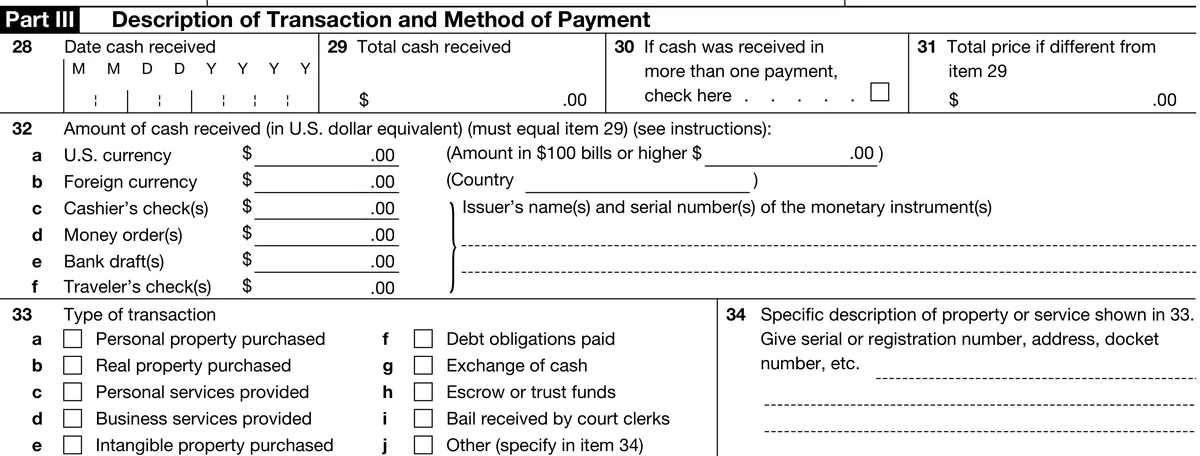
The IRS Form 8300 Reference Guide describes the threshold as more than $10,000. A total of exactly $10,000 does not meet it, while any amount above it does. Cash includes US and foreign currency. Personal checks and bank transfers are not cash for this rule, so a ledger that mixes payment types needs to separate them before any total is tested.
Some monetary instruments sit in between. IRS Publication 1544, revised in September 2014, explains that a cashier's check, bank draft, traveler's check or money order of $10,000 or less can count as cash in a designated reporting transaction, or where the business knows the payer is using it to avoid reporting. An instrument over $10,000 is not cash for this purpose. The publication defines designated reporting transactions and sets out installment and loan exceptions, so check those details there rather than assuming every check counts or that none does.
Sources and context, checked :
When separate payments are related
The reference guide treats transactions between a payer, or the payer's agent, and the business within a rolling 24-hour period as related. Payments further apart can still be related when the business knows, or has reason to know, that they are connected. A deposit, a progress payment and a final balance on one order are a clear case.
For installment payments on a single transaction, the Form 8300 instructions say to total the cash received within one year of the first receipt. The payment that takes the total above $10,000 starts the clock. The return is generally due within 15 days of that payment, and a deadline falling on a weekend or holiday moves to the next business day.
Sources and context, checked :
A hypothetical installment sale
Hypothetical: a continental-US business makes one sale to one customer, who pays only in physical US currency. There are no other payments and no exemption applies. The dates and amounts are invented.
| Date | Currency received | Running total |
|---|---|---|
| June 10, 2026 | $4,000 | $4,000 |
| June 17, 2026 | $3,500 | $7,500 |
| June 24, 2026 | $3,000 | $10,500, threshold crossed |
Reading the result
The first two payments are more than 24 hours apart, but that does not make them unrelated, because the business knows all three belong to the same sale. The June 24 payment takes the total above $10,000, so the return is generally due by July 9, 2026, fifteen days later. If the three payments had totalled exactly $10,000, they would not have crossed the threshold.
Keep the invoice, the customer identification and taxpayer identification number work, the time and amount of each receipt and the filing copy together in one file.
Filing, statements and retention
According to the reference guide, from January 1, 2024 a business generally must file Form 8300 electronically if it is required to file at least 10 other information returns in the calendar year, not counting Forms 8300. Electronic filing uses FinCEN's BSA E-Filing system. Exceptions, and the hardship and religious exemptions, need a separate check before choosing paper.
Required filers generally must give each identified party a statement by January 31 of the following year. Keep the filed form, its support and the customer statement for at least five years from the filing date. An electronic acknowledgement does not replace keeping the form itself.
Sources and context, checked :
Set up the receipt log
The next step is a cash receipt log that shows the whole customer relationship rather than individual deposits. Review open installment arrangements first and confirm each one has a running cash total.
- Link each receipt to the customer, the contract or invoice, and the payer or agent who handed it over.
- Record payment type separately: currency, personal check, bank transfer, or a cashier's check, bank draft, traveler's check or money order.
- When a total passes $10,000, record the crossing date, due date, filing method and proof of submission.
- Diary the January 31 customer statement and keep any suspicious-transaction filing details confidential.