
How to assign a Form 941-X correction to the right quarter
Each Form 941-X corrects one Form 941 you already filed, so the correction belongs to the quarter where the error happened. First name that quarter and year. Then record the date you discovered the error and choose the adjustment or claim process. A first-quarter mistake found in November is still a first-quarter correction. It does not go on the current quarter's Form 941.
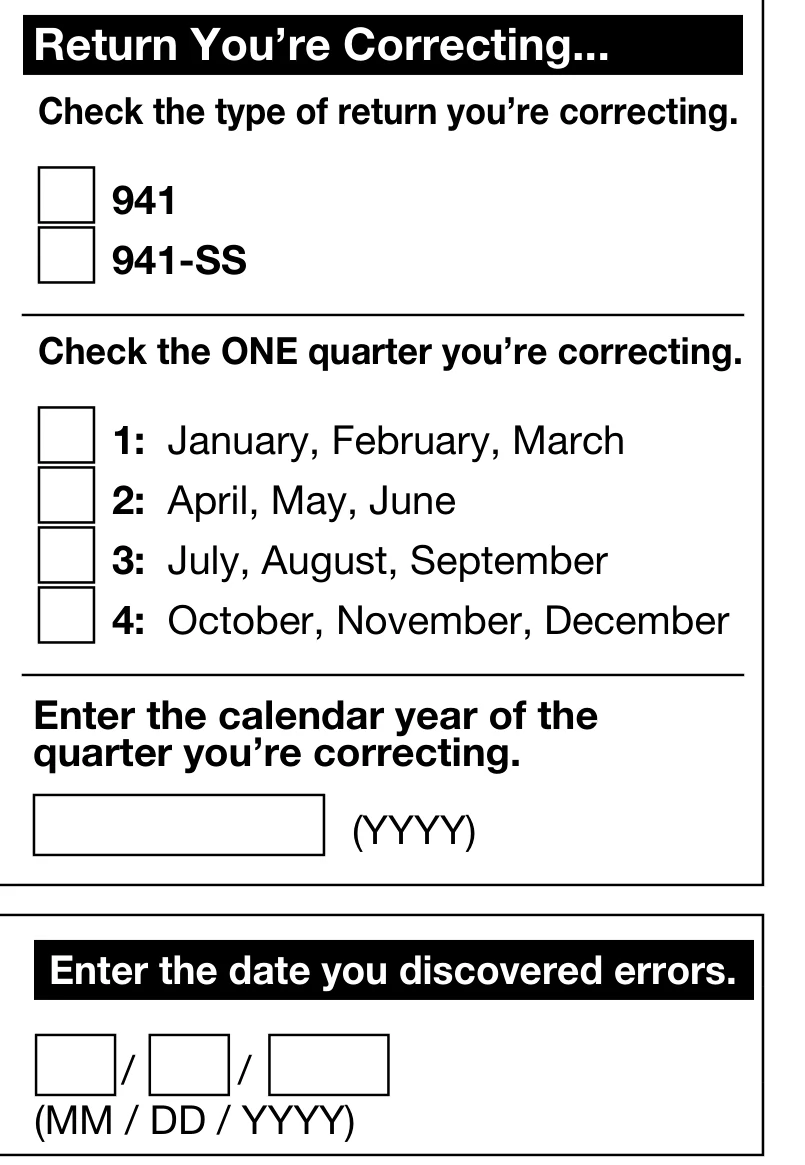
Match each correction to one filed return
The April 2026 IRS instructions require a separate Form 941-X for each previously filed Form 941 you are correcting. You generally file it separately from Form 941. If errors touch three quarters, you prepare three forms, and each one shows the quarter and year of the return it corrects.
A Form 941-X needs an original return to correct. If you never filed Form 941 for a quarter, you ordinarily file the missing Form 941 instead. The instructions contain a special exception for certain worker reclassification cases, which this article does not cover.
Sources and context, checked :
Record when you discovered the error
The IRS treats an error as discovered when you have enough information to correct it. In our reading, that is often the day a reconciliation pins down both the wrong figure and the right one. Your workpapers should show why you chose the date.
If you found errors on one return on different dates, enter the earliest date on the form. Explain the later dates and errors on line 43.
The date matters most for underreported tax. You generally must file Form 941-X by the due date of the return for the quarter in which you discovered the error, and pay the amount you owe when you file. Whether the correction is interest-free depends on meeting the conditions in the instructions.
Sources and context, checked :
Choose the adjustment or claim process
Underreported tax uses the adjustment process in Part 1. For overreported tax you choose between an adjustment that creates a credit and a claim for refund or abatement, subject to time limits. An adjustment return can include both underreported and overreported amounts for that quarter. A refund claim cannot include underreported amounts, so use a separate adjustment return for those.
Overreported tax generally must be corrected within 3 years of the date Form 941 was filed or 2 years of the date the tax was paid, whichever is later. Underreported tax generally must be corrected within 3 years of filing. For these limits, a Form 941 for a calendar year that was filed early is treated as filed on 15 April of the following year.
| Situation | Process | Point to check |
|---|---|---|
| Tax was underreported | Adjustment process in Part 1 | Generally file by the due date of the return for the quarter of discovery and pay when you file |
| Tax was overreported | Adjustment credit, or claim for refund or abatement | Time limits apply to either choice |
| Overreported, last 90 days of the limitation period | Claim process | The adjustment process is no longer available |
| Underreported and overreported amounts on one quarter | One adjustment return can include both | A refund claim cannot include underreported amounts, so use a separate adjustment return for those |
Sources and context, checked :
Hypothetical example: two quarters found on one day
Hypothetical: a bookkeeper reconciling payroll on 4 November 2026 finds that taxable wages were understated on the Forms 941 already filed for the first and second quarters of 2026. The figures are clear enough to correct that day, so 4 November 2026 is the discovery date for both.
The business prepares two Forms 941-X, one for the first quarter of 2026 and one for the second. Neither error goes on the fourth-quarter 2026 Form 941. The tax was underreported and discovered in the fourth quarter, so each form generally is due by the due date of the fourth-quarter 2026 return, with payment made on filing. Confirm that exact date separately, because weekend and legal holiday rules can move it.
Each form gets its own line 43 explanation describing what went wrong in that quarter and how the corrected figures were found.
Fill in the columns and keep the support
The form separates the corrected amount, the amount originally reported or as previously corrected, the difference and the tax correction. On lines 6 through 13, enter totals for all employees, including those the error did not affect. Review whether the correction also requires Forms W-2 or W-2c.
Payroll differences do not all follow one fix. Prior-year federal income tax actually withheld generally cannot be corrected for a nonadministrative error, although an error in reporting the amount actually withheld is a different case. Additional Medicare Tax corrections and the employee repayment and consent certifications carry their own restrictions.
A correction file for each quarter can hold these items:
- The original Form 941 and any earlier Form 941-X for that quarter
- The dated reconciliation or workpaper that identified the error
- Corrected payroll totals for all employees, line by line
- The line 43 explanation as filed
- Payment confirmation for any underreported tax
- Notes from the Form W-2 or W-2c review
Sources and context, checked :