
Form 8941: check who counts before claiming the small employer health credit
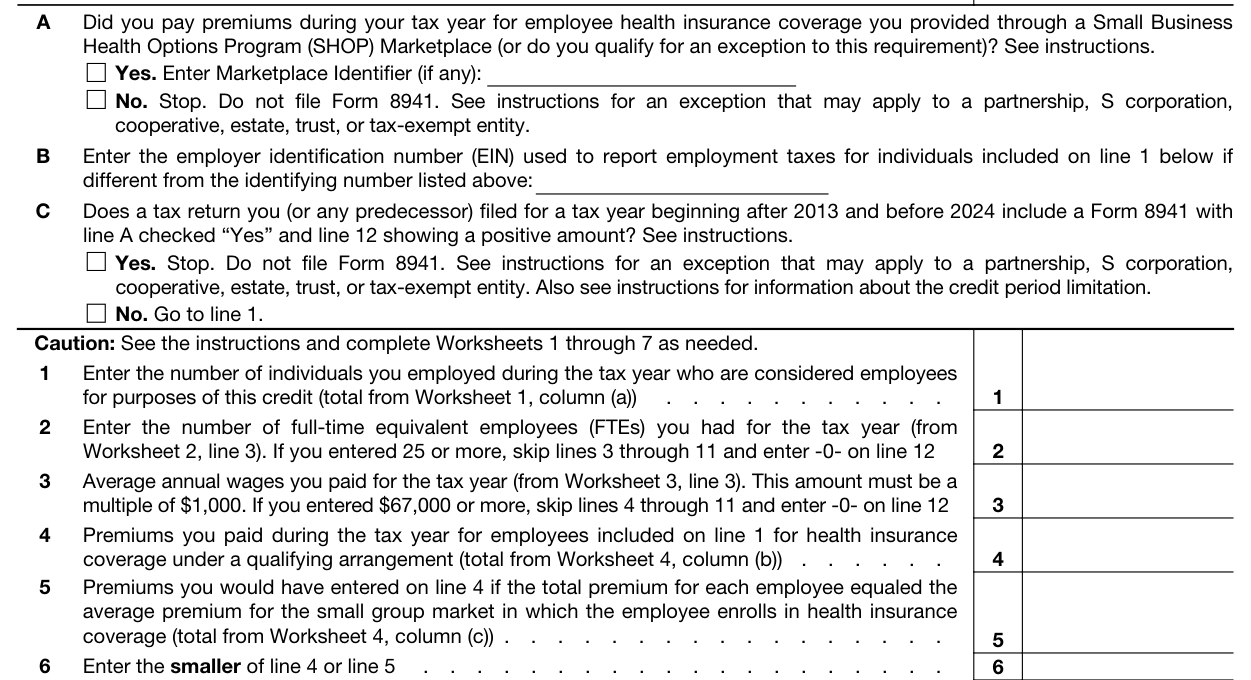
Before applying any percentage to the insurance invoice, confirm the taxable employer qualifies, count FTEs and average wages under the Form 8941 worksheets, confirm SHOP coverage with a qualifying uniform contribution, and check the credit period against the employer's and any predecessor's claim history.
Start with who counts
A small employer receives the year's final health insurance invoice and wants to know whether half of it comes back as a credit. The invoice supplies one input. Employee counts, average wages, coverage type and claim history come first, and any one of them can reduce or remove the credit.
This article covers taxable employers. Tax-exempt employers have a separate 35% maximum and a special limit. The credit is a general business credit claimed against income tax, not a payroll tax credit, and the employer reduces the related premium deduction by the amount of the credit allowed.
Sources and context, checked :
Coverage and claim history
The 2025 instructions generally require a qualifying arrangement in which the employer pays a uniform contribution of at least 50% of the premium, subject to billing and tier rules. Coverage generally must be through SHOP, with limited relief rules that should be read on their own terms. Under the Hawaii waiver, employers in Hawaii cannot claim the credit for health plan years beginning after 2016.
The credit period is two consecutive tax years, starting with the first qualifying year for which a Form 8941 was filed showing Yes on line A and a positive amount on line 12. A predecessor's relevant claim counts in that history. Owner, family and related-employer rules affect who is counted. Seasonal workers who meet the instructions' definition may be excluded from FTEs and wages while their eligible premiums may still count.
Sources and context, checked :
FTEs, wages and the 2025 screens
Hours are capped at 2,080 per worker, and total hours are divided by 2,080 with worksheet rounding. Wages are those subject to FICA, figured without the Social Security wage cap, and the average is rounded down to a multiple of $1,000. An average that is already a multiple of $1,000 stays as it is. The FTE and wage phaseouts are independent and add together.
On the 2025 final Form 8941, a nonzero credit requires fewer than 25 FTEs and worksheet average wages below $67,000. The FTE phaseout starts above 10 FTEs. The wage phaseout starts above $33,000 on the rounded wage screen, with an exact $33,300 baseline in Worksheet 6. These are 2025 figures.
The usual maximum for a taxable employer is 50% of the eligible premium base, generally the lower of qualifying employer premiums and the adjusted small-group market average.
Hypothetical calculation
Hypothetical, tax year 2025: a taxable employer outside Hawaii is in the first year of its qualifying SHOP credit period, makes a qualifying uniform contribution and has no predecessor or aggregation issue. All 26 workers are non-owner regular eligible workers. The actual-hours method includes any qualifying paid leave, and there is no state subsidy or other credit complication. Qualifying employer premiums are $30,000, and the calculated adjusted average employer premium cap is $26,000.
The $10,400 is preliminary and comes before general business credit limits. Passing the screens is a prerequisite and does not by itself produce a usable credit.
| Step | Calculation | Result |
|---|---|---|
| Hours | 10 × 2,080 + 16 × 390 | 27,040 |
| FTEs | 27,040 ÷ 2,080 | 13 |
| Average wages | $426,400 ÷ 13 = $32,800, rounded down | $32,000, no wage phaseout |
| Before phaseout | 50% × lesser of $30,000 and $26,000 | $13,000 |
| FTE reduction | (13 - 10) ÷ 15 = 20% of $13,000 | $2,600 |
| Preliminary Form 8941 amount | $13,000 - $2,600 | $10,400 |
Sources and context, checked :
Documentation checklist
Keep two working lists, one for employee hours and wages and one for enrollees and premiums, and file the supporting records with them.
Finish the hours and wages list and confirm the claim history first. Then open the premium invoice and calculate the premium base.
- Policy and enrollment evidence showing SHOP coverage or the relief relied on
- Employer contribution calculation showing the uniform percentage
- Insurer invoices tied to the premium list
- Benchmark calculation for the adjusted average premium
- Owner, family and related-employer review
- Seasonal worker determinations
- Prior Forms 8941, including any filed by a predecessor
Sources and context, checked :